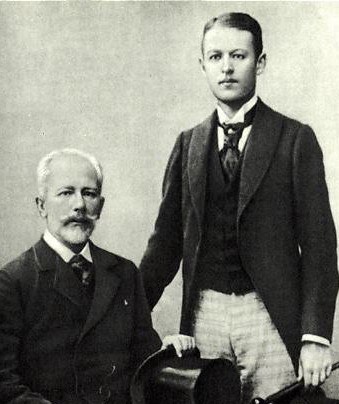
It has been said that Tchaikovsky’s personal life was not reflected in many of his works and the contrasting characteristics in his music simply reflected his creativity. His music was a perfect combination of both emotion and intellect. However, towards the end of his life his works -particularly Symphonies- started to reflect a more autobiographical aspect. His Fourth Symphony is described by Timothy Jackson as the “turning point” or “crisis” in his career as a symphonist.
The Sixth Symphony was dedicated to his favorite nephew, Bob, as a token of deep appreciation. Although this was not the first time Tchaikovsky dedicated any of his compositions to a man, this time was set to be quite different. As Jackson argues, The Pathétique was, in fact, autobiographical. It is fair to say the program revolves around the last chapter of his life’s situations. Anything and everything can be expected of a Tchaikovsky Symphony, and the Sixth was, of course, no exception. Composers and scholars have argued about form and how Tchaikovsky managed to handle technical difficulties. The form of the Sixth Symphony is innovative and unique.
Let us dive into the first movement, which happens to be the longest of all four. This perhaps has to do with the information it stores within. Is the Adagio an introduction for the Symphony? Or is it perhaps a preface or outline that draws upon the first theme in the Allegro non troppo? What is very clear to me is the emotional content of the opening material in the D Major Adagio has to be one of the most honest, sincere and heart-breaking declarations of unrequited love we will ever hear. After nearly 50 letters in correspondence to his nephew Bob and many references of articles and book chapters, the final piece of the puzzle is within Don Jose’s lines:
“Car tu n’avais eu qu’à paraître, qu’à jeter un regard sur moi, pour t’emparer de tout mon être…”
Which means: “For all you needed was to be there, to share one glance with you to long for you with all my being…”
It is not sufficient to think of this as a sexual and race metaphor as Jackson mentions. We must take into consideration the unique empathy that Tchaikovsky felt towards Don Jose’s despair when he realizes that love had poisoned him into madness. Nevertheless, to love and to be loved in return is one of the most powerful feelings a human can experience. Love brings us hope and that same hope is represented in this melody. Tchaikovsky rearranged the harmonic language of Don Jose’s motif and placed it in the Allegro vivo, then again as closing section in the Andante come primo of his first movement (just to show how important was for him). The second movement reflects a much more joyful spirit (if may call it that) presenting a clever contrast after the first one. The third is very celebrational and dynamic without doubt, and the fourth movement seems again tragic -similar to the first. In the later years of his life there is no event that would give him material for this type of composition, but what about his lifelong struggle with his homosexuality? He had to face the fact that it was something he could not outrun and there was no way to win this battle. Adagio Lamentoso might give a hint about something to regret if you imagine a 53-year-old romantically involved with somebody who is barely 20 years old. To be that young means wanting something very different each day at a time, but to be 50 something means that true love is fueled by very different reasons. Forbidden indeed.
Not many would understand what Tchaikovsky was going through, and if we take into consideration the historical context then we must say that no one would ever understand his feelings. But after we listen to his Sixth Symphony who can disagree about placing it at the pinnacle of Tchaikovsky’s achievement? Honesty was his sin.
Jackson, Timothy L. Tchaikovsky: Symphony no. 6 (Pathétique). Cambridge: Cambridge University Press, 1999.
Poznansky, Alexander. “Tchaikovsky: A Life Reconsidered.” In Tchaikovsky and His World, 3-54. Princeton, New Jersey: Princeton University Press, 1998.
 Tchaikovsky Seminar
You mentioned that later on in his life there is no event that would have given him material for such a tragic symphony. This is a unique perspective in that you have considered not just what happened to Tchaikovsky, but what had not* happened in his life. I suppose with this idea in mind, one can narrow down what the tragic areas in Tchaikovsky’s life were, and at least from reading his diaries, the suffering he felt from his homosexual nature was apparent. I really enjoyed your interpretation when you stated that “love poisoned him into madness.” Although we will never be certain about the symphony’s program, this perspective does have reasonable evidence.
LikeLike
Your views are really impressive to me. Guess what, I ever met this opinion that, the core of Pathetique is positive and beautiful, although it is more like a tragedy at the first sight. I prefer to understand the contrasting character between movements as Tchaikovsky’s struggling motions. It could be known from his biography and diary that Tchaikovsky is a extremely emotional and sensitive. Absolutely love is beautiful, and he can not deny and control his emotion and even love. However, many many social and realistic causes were killing his love, which made him frustrated.
LikeLike