IOLANTA
Tchaikovsky’s Last Opera.
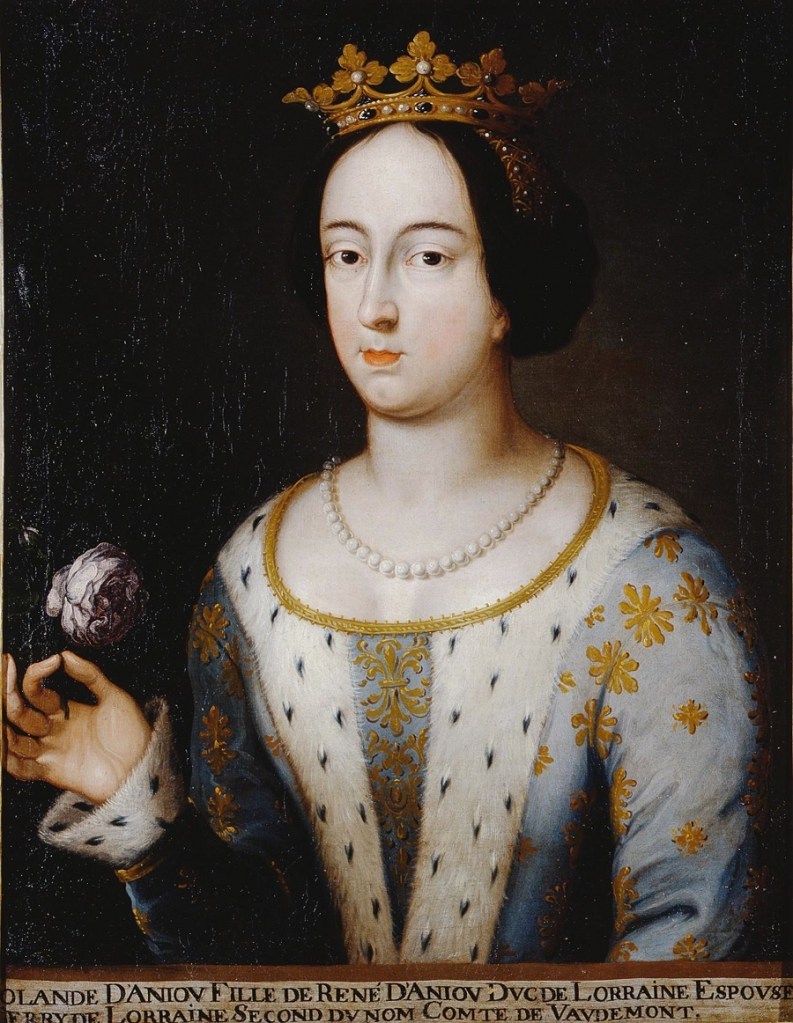
In 1892 Tchaikovsky was approached to write a double-bill spectacle for a Russian audience, a one act-opera and a two-act ballet. He immediately imagined a drama that had caught his attention years back from the Danish writer René Hertz. It was the story of the French Princess Yolande de Lorraine, (‘Iolante’ in Tchaikovsky’s opera). The story tells the misfortune fate of a blind woman. Her father would always make sure she did not know about her own illness, or the fact that she was a princess, until one day a man came the castle to meet her. This man, Vaudémont, let her know the truth, which evoked new situations in everyone’s lives around them.
Tchaikovsky divided this opera in only 4 scenes. I the first one, we meet Iolanta in her beautiful garden, which is always guarded by Bertrand and Martha, who have taken care of her, and to whom Iolanta confesses her habitual sadness. She feels there is something missing in her life. The second scene revolves around a Doctor that presumably could heal her illness, but the King is afraid it might not work. The third scene is where ‘love’ comes along and Iolanta meets Vaudémont. They fall in love at first encounter. We hear a great love duet between them and Vaudémont finds out she is blind. He explains her situation and she face, for the first time, her life’s reality. In the last scene the King finds the couple confessing their love to one another and that Iolanta is aware of her illness. This is the precise moment to give her the treatment she refused. The King uses this in his favor and threatens to kill Vaudémont. Iolanta is left with no choice but to take the treatment. The story ends up ‘Happily ever after’.
Tchaikovsky based the whole opera in one specific moment from the third scene, which is the duet between Iolanta and Vaudémont, and from there he decided to write music before and after. It is fair to say that this is the real climax of the opera in both music and text. This is the moment when reality hits both characters and they decide that Love will overcome the obstacles. The libretto was written by his brother Modest, who had been also in charge of ‘The Queen of Spades’ libretto and had done a remarkable job with it, Tchaikovsky himself wrote “your libretto is quite perfect” in a letter on April 15, 1981.
Tchaikovsky was not thrilled he started working on “The Nutcracker” in 1890 before his departure to America and left “Iolanta” for last. He wanted to get the ballet out of the way and eventually focus on the opera, but at the same time he felt he was repeating himself and would consistently compare “Iolanta” to his previous opera “The Enchantress”. He also expressed he was afraid that after his last one, “Queen of Spades”, he would not be able to exceed both his own and people’s expectations about his work.
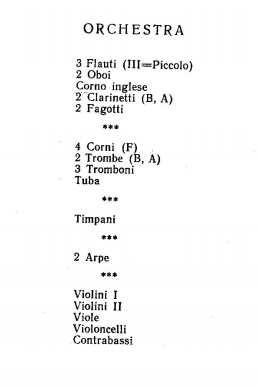
I found the Introduction of the Opera to be particularly interesting, considering the fact that he only used a portion of the orchestra.The orchestration for ‘Iolanta’ is traditional and within the expectations of any opera towards the end of the nineteenth century (perhaps the only thing extra is that it requires two harps). However, in the Introduction there are only wind instruments playing (including of course horns), there is nothing written for strings and percussion.
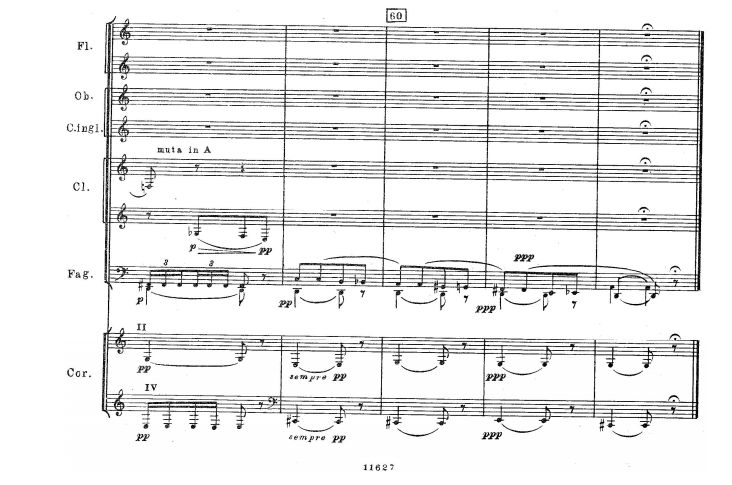
The Introduction’s (Overture’s?) chromatic leitmotiv makes it hard to identify which key we are in, but if we take it further we can say that the whole introduction is, in fact, a preface to Iolanta’s first appearance.The last chord sets the perfect entrance for the first scene. Spanish Scholar Ramón Tener talks about this ‘leitmotiv’ being associated with Iolanta’s sadness and that the portion of the orchestra that is not playing may represent what Iolanta has but cannot use: her eyes. This first scene holds the argument in which Iolanta is set with two ladies always looking after her and we also understand she’s blind. The music is straight-forward using the harps like a ‘romanza’-type atmosphere. After this conversation Tchaikovsky presents Iolanta’s first Aria, in which she describes many of the things she can only hear day-to-day (when there’s light and the sun’s out) and how she feels a void in her life, all of these in the key of G minor.
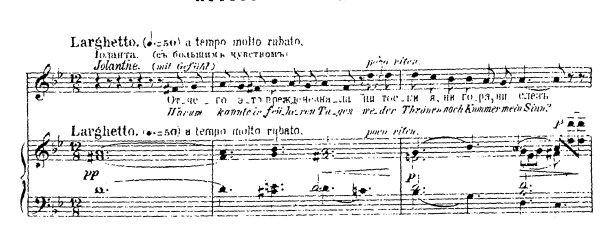
Then there is a great contrast in the modulation to G major (now talking about the night’s beautiful sounds) that embraces a much fuller sound coming from pianissimo to double forte. Dynamics play a very important role in the setting of specific aspects and in this Aria the way he uses ‘ff’ for the night and a major setting contrasting with the ‘pp’ and minor for day gives an incredible musical output.
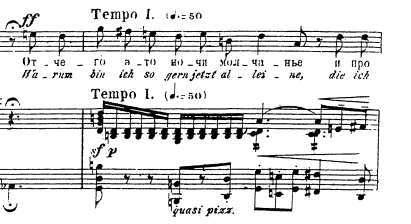
I know it’s very vague to say that certain type of music is ‘beautiful,’ and I fear making myself even more vague, I do honestly think that Tchaikovsky had nothing much to prove to any other composers or even to himself and that Iolanta’s music is just very beautiful. The overall musical direction goes to ‘Love’ (if I may) and the way the composer envisioned it. I understand that for many people it can be boring, Korsakov himself said that this proved to be one of Tchaikovsky’s weakest compositions of all time, but I, for one, think it is a very honest opera with a surprisingly non-tragic end.
Tchaikovsky was in love with ‘Iolanta’ and I guess he felt identified with her. Think of it this way —he had an overprotective father who tried to do his best to take care of his child’s problems. But same as Iolanda, ever since he was little Tchaikovsky felt the same habitual sadness of something that was not clear in his life. Both King René and Petróvich guarded their children from the rest of the world not to ever find out what they were: one blind and the other homosexual.
Lloyd-Jones, David. “A background to Iolanta”. The Musical Times, Vol. 109, No. 1501 (Mar., 1968), pp. 225-226. http://www.jstor.org/stable/953481. Accessed 15 Apr. 2020.
Tchaikovsky Research. “Iolanta”. Iolanta. Last modified on 20 February 2020, at 18:31. https://en.tchaikovsky-research.net/pages/Iolanta
 Tchaikovsky Seminar
It is a very interesting context of the opera, and how Tchaikovsky began the overture with only winds is very different from other operas. Perhaps, he could to imply that Iolanta is ‘incomplete’ because she is blind? On the other hand, it is not strange that Tchaikovsky has chosen scripts with controversial themes and in which the protagonist is in a certain way a ‘martyr’, but what makes me think, how could Tchaikovsky have identified with the character? Perhaps because he wanted to live his ‘homosexual’ life as a blind man without caring about the opinion of others? Or maybe he wanted the world to be blind so that he could be completely happy?
LikeLike
It is a very interesting context of the opera, and how Tchaikovsky began the overture with only winds is very different from other operas. Perhaps, he could to imply that Iolanta is ‘incomplete’ because she is blind? On the other hand, it is not strange that Tchaikovsky has chosen scripts with controversial themes and in which the protagonist is in a certain way a ‘martyr’, but what makes me think, how could Tchaikovsky have identified with the character? Perhaps because he wanted to live his ‘homosexual’ life as a blind man without caring about the opinion of others? Or maybe he wanted the world to be blind so that he could be completely happy?
LikeLike
The world would have to be more than just blind, I think. For one Iolanta grew up with out a mother, Marta took care of her but was not her Mom, she was in fact the King’s Wife, it’s a little confusing actually but I guess Tchaikovsky always felt out of place just like Iolanthe did. And the two harps situation is very unfortunate, I guess he thought that was going to be very popular. You will need not one but two Yamaha keyboards nowadays.
LikeLike
“Love at first interaction” was clever 😉 I find the connection between Iolanta’s sadness and missing sight to Tchaikovsky’s homosexuality an interesting one. The fact that the climax and pinnacle of the opera is meant to convey the idea that love conquers all is also interesting–is this an idea that Tchaikovsky believes in? Is it an idea that he wishes could be true for him? Because, of course, his homosexuality (in the 19th century) made it difficult for him to find fulfillment in a romantic love scenario. Homosexuality aside, I find the plot of this opera to be supremely strange. How would a person not understand that they are blind? Tchaikovsky’s treatment of the emotional concepts are clever: the smaller orchestra for a more sad or even “incomplete” sound, the G major key for night time when Iolanta would be less likely to feel like there was something just beyond her reach and therefore probably a less troubling time of day, etc. I’m glad it has a happy ending, even though his audiences seem to be desperate for crazy drama!
LikeLike
Thank you very much for your comment Andrea, I for one think that Tchaikovsky felt very identified with Iolanta and he identified his own Father to King René. Iolanta was born as a blind child (at least in the Story) perhaps humans do not miss what they’ve never had right? Nevertheless Iolanta felt like there was something missing in every step of the way. And YES, LOVE was an idea that Tchaikovsky wished was true for him… easy and clean. Like that’s ever possible…
LikeLike
”They fall in love at first… first encounter”- This made me laugh hahahaha. The fact that Tchaikovsky decided to write the music based on the love duet scene, the climax, is interesting. I never think of composers creating music for any kind of theatrical show starting from the middle. The fact that his brother Modest wrote the libretto was also a cool fact and made me think of the joy he most of had being able to create something remarkable with a family member.
I really love the symbolism in Tchaikovsky’s works. Thank you for pointing out the leitmotif representing sadness and the portion of the orchestra not playing representing Iolanta’s blindness. Also, Tchaikovsky’s use of fortissimo and a major key for night and the opposite for day is unexpected. So cool! I suppose this level of sophistication could definitely be overlooked, and it makes me a little sad that audiences mostly pay attention to surface details unless the inner workings of a piece are explicitly laid out.
LikeLike