Andrea Davis
In January of 1889, just before Tchaikovsky departed on his second foreign tour, he began composing The Sleeping Beauty. Working throughout the year, and in collaboration with Ivan Vsevolozhsky and Marius Petipa, the ballet was completed in approximately forty days total. The Sleeping Beauty premiered in January of 1890; while critical reception was unenthusiastic, Tchaikovsky himself was pleased with his work.
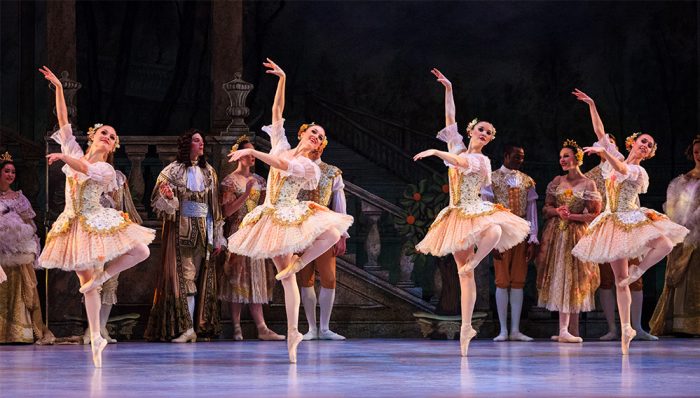
The Valse is the first set piece in the ballet, and it opens Act 1. It is danced by peasants who have just been pardoned from a prison sentence while the King and Queen look on. The lighthearted tone of the Valse contributes to the celebratory nature of the pardon, and prepares the stage and atmosphere for Princess Aurora’s arrival.
The Valse begins with an exciting introduction that has a sweeping motive that moves sequentially upward with an almost frenetic energy. The entire introduction is played over an F major dominant pedal point that makes the arrival of the main waltz theme in B flat major especially pleasant. I would argue that the Valse is in ternary form. Following the introduction, the A section of the Valse consists of the main theme, a second theme, and a return of the main theme. A quick modulatory transition takes us from the A section into the B section. The A section then returns as expected.
Theme 1 – Theme 2 – Theme 1 Theme 3 Theme 1 – Theme 2 – Theme 1
|_____________A_______________| |___B____| |_______________A______________|
Theme 1 has a singing melody played by the strings. Typical waltz accompaniment in the orchestra supports the melody. Theme 2 is bright and lively, with a running melody again played by the strings. Each phrase ends with a syncopated and elided cadence that is punctuated by the brass and timpani. When theme 1 returns, the melody is accompanied with a light and leaping figure played by the flutes and clarinets. The overall feel of the A section is happy and charming.
The B section, and theme 3, is in the key of E flat major, but half cadences (in B flat major) and a cadence in G minor (flat III) give this section a less stable harmonic feel. The melody has a lilting and sweet quality that is enhanced by the glockenspiel playing in unison with the flutes and oboes. As the phrases of theme 3 repeat, the anticipated cadence in G minor is replaced by an almost abrupt shift to an F dominant 7 chord (and half cadence in our original key of B flat major.)
The quick shift back into B flat major moves us into the return of the A section. This is a literal repeat of the previous A section material, and the familiarity of the melodies and themes serves to enhance the happy and contented mood of the Valse. As the A section draws to a close, the Valse ends with a big finish that is punctuated by quickly moving chords and a prolonged perfect authentic cadence that bounces between I and V for the last 7 measures of the piece. Exuberant and exciting, the Valse succeeds in creating a delightful and charming atmosphere.
The music of The Sleeping Beauty is beautiful and refined, and a more mature Tchaikovsky is apparent in its composition. The Valse is not considered the pinnacle of the ballet, but its attractive and elegant melodies make it an enduring piece in its own right. Despite the lukewarm critical reception at its debut, Tchaikovsky was happy with his accomplishment. He said, “…the music from this ballet will be amongst my best works. The subject is so poetical, it is so suited for music, that in composing it I was utterly absorbed, and wrote with a fervor and passion which always results in work of merit.” His passion is apparent, and the music of The Sleeping Beauty could, indeed, be counted among Tchaikovsky’s greatest works.
Bibliography
Brown, David. Tchaikovsky: The Man and His Music. New York: Pegasus Books, 2007.
Tchaikovsky Research contributors, “The Sleeping Beauty,” Tchaikovsky Research, http://en.tchaikovsky-research.net/index.php?title=The_Sleeping_Beauty&oldid=77021 (accessed April 14, 2020).
Wiley, Roland John. “Tchaikovsky, Pyotr Il′yich.” Grove Music Online. 2001; Accessed 14 Apr. 2020. https://0-www-oxfordmusiconline-com.lib.utep.edu/grovemusic/view/10.1093/gmo/9781561592630.001.0001/omo-9781561592630-e-0000051766.
 Tchaikovsky Seminar
Thank you for your excellent essay to introduce this piece. There is no doubt Tchaikovsky is a master of composing ballet music. I agree with your view that the music of The Sleeping Beauty is unique and more mature work among his composition. As you’ve talked in the video last week, the music might overshadow the drama. I think it is exactly that is where its value lies.
LikeLike