by Preston Griffith
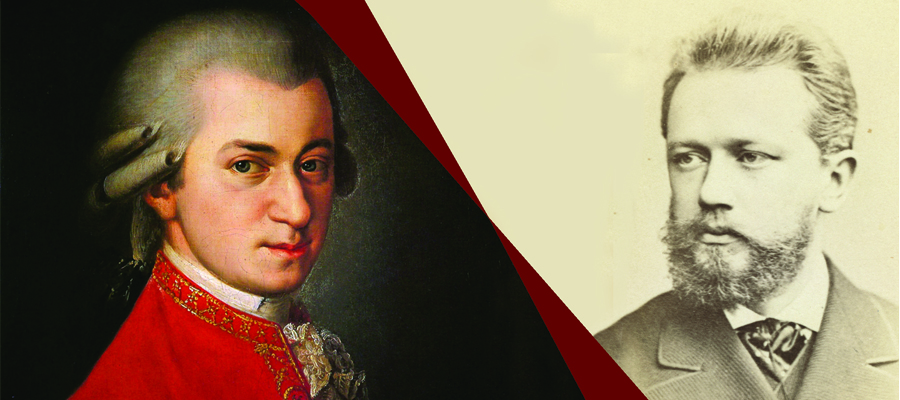
Tchaikovsky first had the idea of composing a suite from the works of Mozart in 1884 while he was working on the recitatives and translation of Mozart’s The Marriage of Figaro. He was enamored with Mozart’s compositions and played them on the keyboard in his free time. After a few years, he still held on to the idea and began work on the piece after choosing selected pieces by Mozart in Jurgenson’s store in 1886. The pieces each came from Mozart’s compositions for keyboard. In the summer of 1887, he completed the Suite No. 4, and Jurgenson convinced him to name it Mozartiana. The first performance was conducted in November of that year in Moscow at the second symphony concert of the Russian Musical Society.
The Suite is scored for a full orchestra consisting of 2 flutes, 2 oboes, 2 clarinets (in A, B-flat, C), 2 bassoons, 4 horns (in F), 2 trumpets (in B-flat), 3 timpani, cymbals, glockenspiel, harp, violins I, violins II, cellos, and double basses. Each section (Strings, woodwinds, brass, and percussion) had a different role within the piece in terms of the instruments range in relation to the ranges written originally by Mozart for keyboard. In general, there are few spots where the full orchestra plays together. Most of the piece features these instrumental sections trading off the melodic line so that it may be played higher, lower, or with a different timbre.
As stated previously, Tchaikovsky’s Suite No. 4 was based off of different compositions by Mozart. In fact, Tchaikovsky wrote a short foreward in his score that states his intentions for the piece concisely:
“A large number of Mozart’s outstanding short pieces are, for some incomprehensible reason, little known not only to the public, but even to many musicians. The author who has arranged this Suite entitled “Mozartiana” wished to provide a new impetus for the more frequent performance of these gems of musical art, unpretentious in form, but containing incomparable beauties” — Moscow, 5 October 1887. P. Tchaikovsky.
The first movement of the suite, Gigue, was arranged from Mozart’s Eine kleine Gigue for keyboard (KV 574).
The first link above is the original piece Tchaikovsky arranged for his first movement. The performance is Mozart’s Kleine Gigue in G, K.574, played by Mitsuko Uchida for a comparison. The second link is Tchaikovsky’s Suite No. 4 performed by the National Symphony Orchestra of Ireland. The first movement, Gigue, is in G Major and very short. The entire movement is only about 2 minutes in length, and is in 6/8 time with an Allegro tempo. Instruments enter and fade out based on their range relative to the piano as one can surmise from watching just the first minute of each video. For instance, violin I and flute enter and have material together, clarinet and violin II are paired, bassoon and viola, and cello and bass. The brass instruments are much less involved in this movement. Notes are clipped and played with a short staccato articulation to emulate the piano and held notes and chords only sound as long as a piano would be able to hold them.
Tchaikovsky’s second movement, Menuet, is played at a Moderato tempo and is in D major. This movement can be found at minute 2:08 in the above recording. It was arranged from Mozart’s Minuet for keyboard (KV 355/567b), which can be heard in the first of the two links above with a performance by Luc Devos. Suite No. 4’s Menuet is written in ¾ time with much more chromaticism. One can hear a chromatic ascent in the lower part that comes out in a loud forte. In comparison to Tchaikovsky’s Menuet, Mozart’s Minuet for Keyboard has a sharper contrast in dynamics. Mozart’s composition contains terrace dynamics with either forte or piano written mostly. In comparison to the original keyboard part, the strings are able to cover a broader range of dynamics and swell within held notes. Tchaikovsky’s orchestral arrangement has a more majestic legato tone, and the texture is much thicker with multiple instruments able to take over the different parts that normally would limit a pianist to a smaller dynamic range.
Pregheira, Suite No. 4’s third movement, is written Andante non tanto in B-flat major and starts at 6:25 in the recording. This movement is unique because it is actually an arrangement of an arrangement. Tchaikovsky arranged his Pregheira from Franz Liszt’s piece À la Chapelle Sixtine, S.461 (1862), which itself was a solo piano transcription of Mozart’s motet Ave verum corpus. Mozart’s composition was originally written for voices, strings and organ, K.618 (1791), and can be heard in the first of the three recordings above.
The main melody of Tchaikovsky’s third movement was taken from the Andante con pleta piu tosto Lento section of List’s piece, heard at minute 5:00 in the second video. The movement starts with a rising progression from the woodwinds that blends nicely into the main melody played by the strings. A beautiful, lush melody is played by the strings with a continuously swelling dynamic with winds mostly playing the harmony part. The flutes, however, play the melody along with violins whenever they enter together. Towards the end, the woodwinds echo the melody part heard previously by the strings. Finally, the movement finishes with the high strings playing in their upper register and slowly fading away, creating a heavenly effect.
The fourth movement of Tchaikovsky’s Suite No. 4 is entitled Thème et variations and begins at 9:47 in the recording. The tempo is labeled Allegro giusto and there are ten variations of the theme within this long movement. The last movement takes up more than half of the piece and was arranged from Mozart’s Variations on the theme “Unser dummel Pöbel meint.” Tchaikovsky’s orchestral arrangement was taken more directly from the original composition as you can hear from the recordings above.
In the first variation, the first phrase played by the strings is answered by the woodwinds in the second phrase and this interplay between strings and winds continues throughout. Percussion embellishes the music of the second movement, and this is a key difference between the original and Tchaikovsky’s arrangement. There is also a call and response between the horns and violins in the second half of this variation. At minute 12:02, the Third variation is short and features a flute solo taking the melody with the rest of the orchestra accompanying. This is the first solo of the movement.
At 12:46 in the video, the fourth variation is a larger section with the whole orchestra. The conversation between instruments is now between the lower instruments and higher instruments. The fifth variation is located at 13:32 and is in a minor key. This variation is played with much smoother articulation, longer connected notes, and provides a nice difference from the other movements. The sixth variation at 14:38 features just the woodwinds back in a major key with lots of trills in the lower woodwinds and a lively melody in the upper woodwinds. At 15:27, The seventh variation is much slower and played with a broad, majestic quality by the string section. The eighth variation afterward at 16:43 is played with very fast doubled note string accompaniment. The melody is in the percussion playing glockenspiel.
As a violinist, my favorite variation comes next. At minute 17:37, the nineth variation starts with a violin cadenza and continues with a solo and string accompaniment. At 18:33 the variation continues with the violin solo containing very virtuosic scaler passages spanning a large range and some trill embellishments. The accompaniment from the orchestra is very sparse. The orchestra enters with a thicker texture for a short span at 20:05, and then the solo violin plays some very fast 2 note clipped slurs to even higher parts of the instrument not previous played. The scaler passages are like before, just with different style and articulation while being in a higher range.
Finally, at minute 21:38, the tenth and final variation begins with the orchestra taking back the melody and the high strings staying in the middle register mostly. The brass have a prominent role in this variation with some held chords giving stability to the faster notes being played in the strings. About midway through the tenth variation at 22:36, a famous clarinet cadenza and solo occurs. The movement ends with the orchestra playing fast scaler passages.
Tchaikovsky’s Suite No. 4 is a beautiful piece that is different from his other compositions as he is focusing on the works of Mozart. After reading the foreword written in the score, I believe that Tchaikovsky accomplished his goal of introducing the public to some wonderful shorter works by Mozart in an orchestral form rather than on keyboard. His orchestration translates well to a symphony and is very enjoyable to listen to. As a violinist, I am thankful for the opportunity to play such works.
Citations:
Tchaikovsky Research contributors, “Suite No. 4,” Tchaikovsky Research, http://en.tchaikovsky-research.net/index.php?title=Suite_No._4&oldid=78964 (accessed April 13, 2020).
Wiley, Roland John. “Tchaikovsky, Pyotr Il′yich.” Grove Music Online. 2001; Accessed 13 Apr. 2020. https://0-www-oxfordmusiconline-com.lib.utep.edu/grovemusic/view/10.1093/gmo/9781561592630.001.0001/omo-9781561592630-e-0000051766.
 Tchaikovsky Seminar
What a cool piece! I really appreciated the original Mozart pieces next to Tchaikovsky’s arrangements that you linked in your post. I think Tchaikovsky did a great job capturing the feel of Mozart’s original works. If I were listening to this with no context, I would think Mozart over Tchaikovsky. I preferred the second movement and the theme and variations movement in orchestral form over their keyboard component. I like the richness, and the swell of dynamics that you mentioned, in the orchestra as compared to the piano versions. I agree wholeheartedly with Tchaikovsky: Mozart is a master at creating charming and lovely melodies.
LikeLike
Amazing composition and detailed thorough analysis! The original intention of Tchaikovsky composing this suite is cool that he would like to share Mozart’s pieces that are outstanding but little known. Several composers would like to rearrange late composer’s works, such as Franz Liszt’s Grandes études de Paganini and Fantasy on Themes from Mozart’s Figaro and Don Giovanni. The same tune interpreted by orchestra has more rich and lyrical tone, and also Tchaikovsky slightly changed the character of Mozart’s original tune. I preferred the Tchaikovsky’s arrangement of the Kleine Gigue. As the first movement, it started with a graceful opening. Tchaikovsky enriched the texture of the theme and put it in different part, making it much catchier.
LikeLike