By Aníbal Acevedo
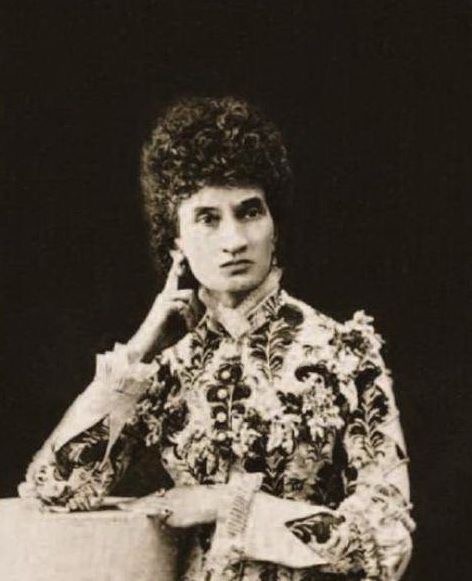
Besides his mother, there were two other important women in Tchaikovsky’s life; (1) his short-term wife Antonina and (2) Nadezhda, his best friend in the world. It all started with a request she made to him about violin and piano arrangements, and in the same letter she acknowledges how she felt, almost like a declaration of love and a fantasy vision about him. This would set off a vast correspondence over the next thirteen years of their lives (1876 to 1879) in which they exchange at first feelings of mutual admiration and perhaps love (which of course was only and ‘idea’ since they never met), but quickly the formal tone of the first letters became more intimate within the first year. In 1877 Tchaikovsky starts to write about ‘Marriage’ and how his family would like for him to considered it, and in an attempt to please his father, he marries Antonina. It only took about two months from the first letter to von Meck about it until it actually happened, but at the time she knew there were some pieces that didn’t fit all together. A couple of months later, after his failed marriage and while Tchaikovsky was having a crisis, she asked him to fully explain himself about the situation. Nevertheless, she had her conjectures and resolutions about why it happened. From this point until the end of their relation around 1890, just three to four years before both of them died, Tchaikovsky would lean and rely on her for everything he needed; von Meck was his primary benefactor but also his greatest confident. The first two years of communication with her were crucial for Tchaikovsky’s life. His personal issues set a test for von Meck’s love which started with a fascination for a man that to her eyes was flawless. Soon she had to accept that not only he did not love her the same way but he was willing to spend his life with someone that did not understand him as von Meck did. Among other things, he shared with her many of his compositional methods and their musical tastes and ideas were very similar. I think perhaps in Tchaikovsky’s heart, she loved her the same way he loved his mother.
As I read the letters, I was intrigued by a special one that talked about the 4th Symphony while he was staying in Venice around December of 1877 (number 63). The thing that I admire the most is how he dedicated the whole symphony to von Meck. I can read him full of excitement about this work, and how he wanted this to be the best thing he’s ever composed. He even wrote a note at the top of the manuscript saying that in case he died, this had to be handed to N.F von Meck. He also talked about feeling better after his post-marriage crisis and called the 4th ‘our symphony’. Maybe in a way he was deeply grateful to her for being a light in those dark times in his life, and I quote “How pleased I am that it is ‘ours’ and that when you hear it you will know I was thinking of you every bar”. It does not get more explicit than that.
In February of 1878 (number 89), Tchaikovsky started to work on the vocal score for ‘Eugene Onegin’. According to the letter there were some rumors about the whole of his opera being already at Moscow, and that it was about to be performed in the Bol’shoi Theater, but that was not the case. He wanted his Opera to premiered first at the Conservatoire as some his previous works had been conducted by Rubinstein. He wanted to set the perfect conditions for his ‘Onegin’ and no one else’s. He also wanted Jurgenson to published it but without any hurry at all. Tchaikovsky also talks about how great he feels, and is grateful is to her as well as his two brothers for helping him out of the abyss, always saying he is indebted to her and wishing the best.
Sadly by 1890 she was the one that put an end to this correspondence and his allowance. At the time Tchaikovsky was already making some money on his own, so this did not affected him economically speaking. Naturally they drifted apart over the years, taking into consideration that Tchaikovsky started to travel more in recent years (since 1880 visiting the US), and von Meck’s health became fragile as she grew old (she could not write by herself anymore) and finally the communication became less intimate and less frequent.
Tchaikovsky, Pyotr, and Meck, Nadezhda. To My Best Friend: Correspondence between Tchaikovsky and Nadezhda von Meck 1876-1878. Trans. Galina von Meck. Edited by Edward Garden and Nigel Gotteri. Oxford: Clarendon Press, 1993.
Brown, David. Tchaikovsky: The Man and His Music. New York: Pegasus Books, 2007.
 Tchaikovsky Seminar
I enjoyed reading your findings on Tchaikovksy and his Fourth Symphony. It is indeed interesting that he asked on his manuscript that the score be given to von Meck should he meet an early death! I also think that the fact that he calls the symphony “ours” illustrates the notion that von Meck is more than a benefactress. As you say, Tchaikovsky would “lean and rely on her for everything he needed” and she is his greatest confidant. In a way, Nadezhda von Meck was probably seen as more of an equal partner in their relationship. This is further shown by von Meck’s willingness to comment on Tchaikovsky’s work in an honest manner and encourage him to pursue certain artistic endeavors.
Your post is similar to mine in that we both discuss Tchaikovsky’s work on Onegin and how particular he was about the production. Like you said, “He wanted to set the perfect conditions for Onegin and no one else’s.” We are lucky to be able to read such descriptive language about Tchaikovsky’s process of composition!
LikeLike
I agree with your statement on how the correspondence hinted at the idea of feelings of love. It is similar to my blog post. Although they never met, the clever choice in vocabulary and expression used in the correspondence makes that idea plausible. For example, in Letter 13, she refers to him as the “pure minister of my beloved lofty art.” This compliments your statement of how she had a fascination for a seemingly flawless man. Also, your research on the Fourth Symphony was quite fascinating. We all knew that the symphony was dedicated to Von Meck, but I’m really glad you mentioned how it would be dedicated to her in the case he was to meet an early death! He really thought so highly of his friend that a contingency for that. Amazing! One thing to add at the end of your conclusion: although it is true that the correspondence gradually became less intimate, her last letter to Tchaikovsky made sure to end on an intimate note. “Goodbye, my dear, incomparable friend. Do not forget one whose love for you is infinite.” Though the letter was not written by her, the sentiment was truly there for one last time.
LikeLike
I agree with you about the relationship with nadezhda. It was a kind of admiration and love. They shared most of their lives and shared opinions on different topics. their conversations were so deep, touching many topics such as the meaning of love, life, music, etc. Nadezhda was not only an intimate friend, but she was also a great support for Tchaikovsky’s life, especially after her disastrous marriage. She was also a good critic on her music, as she provided comments on some of her works. In general, she played a crucial role and I believe that, without Nadezhda, the composer’s life could have taken another path.
LikeLike