Tchaikovsky’s Second Work for Violin and Orchestra, Valse-Scherzo, Op. 34

by Preston Griffith

Tchaikovsky(Right) and his pupil, the violinist Iosif Kotek(Left).

Tchaikovsky’s Valse Scherzo, Op. 34, composed in 1877, was his second work composed for solo violin and orchestra.  The piece is one movement, Allegro Tempo di Valse, and is about six to nine minutes in length.  The Valse Scherzo is dedicated to Tchaikovsky’s former pupil at the Moscow Conservatory, Iosif Kotek.

In 1877, Tchaikovsky had known Iosif Kotek for around six years according to a letter to his brother Modest Tchaikovsky, and he felt “a passion rages with me with unimaginable force” for Kotek at the time.  He made a confession of his love for Kotek, but the love was not returned.  The two talked about many things, including the piece Valse-Scherzo, Op. 34, which Kotek had ordered for a concert coming soon that year.

Tchaikovsky was also in the midst of composing his Symphony No. 4 and the opera Eugene Onegin in 1877, so he was very busy.  Still, he managed to complete the Valse-Scherzo, and Iosif Kotek helped orchestrate the piece from his manuscript.  The piece was also arranged for piano and violin. Kotek gave a private performance of the piece before the premier by Stanisław Barcewicz at the third Russian concert in Paris, 1878.

Right from the beginning, the piece has a bombastic effect in which the virtuoso violinist shows their skills.  In C major, performance practice allows for the violinist to begin with a mixolydian ascending scale up the low G string reaching up to an A and play short eighth notes written with all down bows.  The complicated techniques required to play the piece are recurring. The techniques span almost the entire range of the violin with the violinist’s fingers flying up and down the fingerboard. Complicated double stops are written for the soloist to play two or more notes at once, such as thirds and octaves that are very hard to keep in tune. As for bow technique, lots of spiccato, ricochet, and even upbow staccato are there to give the short, pecking kind of sound heard on the violin.

The Valse Scherzo sounds wild and powerful and one is not sure of it’s waltz nature except for the orchestral accompaniment (or piano accompaniment) playing the classic “boom chic chic” rhythm. The central section of the piece is more lyrical and showcases the sweet almost mystical effect the violin is able to produce with a soaring melody high on the E string.  The piece has a large range of dynamics written, but is mostly played with a loud dynamic. Based on recorded performances, these dynamics are more of a color change than a change in volume. This is accomplished by playing the same notes higher up on a lower string to give a warmer tone color, or by varying the intensity of articulation or vibrato. No other instruments have a solo part in this piece.

Tchaikovsky’s Valse Scherzo, Op. 34 is another treat to listen to, and not common to hear given it’s technical difficulty.  Iosif Kotek must have been an accomplished violinist to play such a work, and indeed asks Tchaikovsky in a letter at one point about studying with the famous Joseph Joachim in Berlin. Enjoy the two performances below of Augustin Hadelich playing the piano arrangement, and Itzhak Perlman playing the orchestral version linked below.

Augustin Hadelich Performance
Itzhak Perlman and Leningrad Philharmonic

Citations

Brown, David. 2007. Tchaikovsky: the Man and His Music. New York. Pegasus Books LLC.

Tchaikovsky Research contributors, “Iosif Kotek,” Tchaikovsky Research, , http://en.tchaikovsky-research.net/index.php?title=Iosif_Kotek&oldid=74404 (accessed February 20, 2020).

Tchaikovsky Research contributors, “Valse-Scherzo, Op. 34,” Tchaikovsky Research, , http://en.tchaikovsky-research.net/index.php?title=Valse-Scherzo,_Op._34&oldid=68642 (accessed February 20, 2020).
Tchaikovsky’s Sérénade mélancolique

By Preston Griffith

Itzhak Perlman playing Sérénade mélancolique, op. 26.

In February of 1875, Tchaikovsky composed his first work for solo violin and orchestra, Sérénade mélancolique, op. 26.  The piece was dedicated to Leopold Auer, one of the greatest Russian Violinists and an extremely successful teacher, but he delayed the piece’s premier.  Adolf Brodsky was the first to play the piece nearly two years later for the seventh symphony concert of the Russian Musical Society in Moscow, and it has become part of the repertoire for violinists since. Sérénade mélancolique is not played often today, but it is a very pleasant piece and has Tchaikovsky’s beautiful, well crafted melodies that are known to leave an impression on the listener.

At around 10 minutes in length, Sérénade mélancolique is a single movement work, and interestingly contains material from two of Tchaikovsky’s previous works from years prior.  The first sounds are taken from Tchaikovsky’s Vakula/Cherevichki, a comic-fantastic opera in four acts. One can hear the clear melody of the flute at the beginning of Sérénade mélancolique playing material from the beginning of Act two Scene two of Cherevichki.

Vakula/Cherevichki Act 2 Scene 2

In this scene, the beautiful Oxana challenges Vakula to obtain the Empress’s shoes, or her Cherevichki, in order for her to marry him. At 0:15 in the video when Oxana sings the word Cherevichki, she is singing part of the melody that makes up Sérénade mélancolique.

The second work that Tchaikovsky borrows from is his famous First Piano Concerto. The French Chanson from the faster central section of the Piano Concerto’s Second Movement is transferred to the central section of the Sérénade mélancolique.

Tchaikovsky Piano Concerto no. 1 2nd Movement, played by Martha Argerich

The French Chanson can be found at 3:59 of this video featuring Martha Argerich.  The rhythm may be different, but one can hear the same melody in the first video of Itzhak Perlman at 4:26.

Tchaikovsky may have self borrowed from earlier works, but the result was a magnificent piece. Sérénade mélancolique begins with the clear sound of the flute and oboe along with the low rumble of cellos and basses and transitions from Db Major to Bb minor. The infinitely sad sound of the violin playing on its lowest G string creates a sense of foreboding, but whenever the music transitions back to Db Major there is feeling of hope again like the blooming of flowers in Spring.  The form of Sérénade mélancolique is a Symmetrical Rondo Form, or ABACABA. The C section, or the climax of the piece and the quoted French Chanson from the Piano Concerto, has a powerful and majestic quality and the virtuosity of the violin soloist shines through.  The clarinet and flute take over the melody afterwards with the solo violin accompanying. The violin takes back the theme at the very end and fades away with orchestral pizzicato. The dynamics could be seen as an arc shape from beginning to end, starting soft, climax in the middle, and softly fading away at the end.

Overall, Sérénade mélancolique, op. 26 is composed well and has sparse accompaniment to support the violinist’s rich melody. The piece is scored for solo violin and an orchestra made up of two flutes, two oboes, two clarinets (in B-flat), two bassoons and four horns (in F) and violins I, violins II, violas, cellos, and double basses. The texture is relatively thin with chords being held by strings or horns, or there is string pizzicato in order to stay underneath the sound of the violin soloist. There are occasional melodic interjections by the flute, oboe, or clarinet.  This piece is another wonderful example of Tchaikovsky’s incredible ability and beautiful composition style.

Citations

Brown, David. 2007. Tchaikovsky: the Man and His Music. New York. Pegasus Books LLC.

Tchaikovsky Research contributors, “Sérénade mélancolique,” Tchaikovsky Research, http://en.tchaikovsky-research.net/index.php?title=S%C3%A9r%C3%A9nade_m%C3%A9lancolique&oldid=68638 (accessed February 10, 2020).

Ruines d’un chateau and Tchaikovsky’s Souvenir de Hapsal

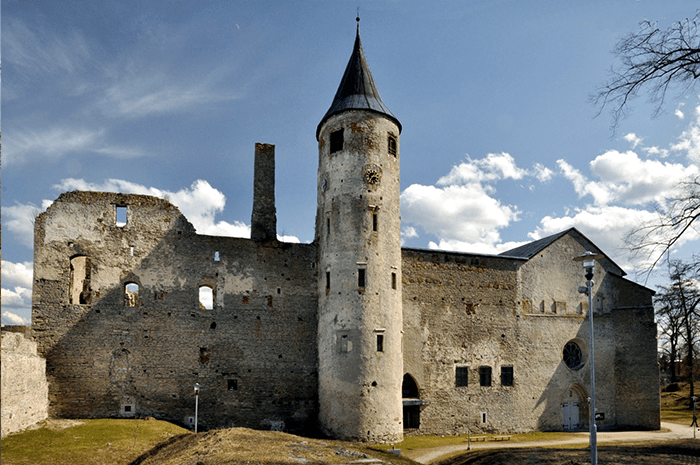
Haapsalu Castle, Estonia

Andrea Davis

Tchaikovsky’s three string quartets (the composition of a B flat first movement beginning in 1865, the third quartet reaching completion in 1876) were all successful, and it would seem that Tchaikovsky had an aptitude for the genre. His solo piano works, also successful among his audiences and colleagues, were smaller pieces meant for salon settings. Despite their popularity, Tchaikovsky spoke about his piano compositions with dissatisfaction. Although he may not have developed a personal style that could compete with pianists like Chopin or Liszt, Tchaikovsky’s piano repertoire is still attractive and engaging.
Souvenir de Hapsal is a cycle of three piano pieces that Tchaikovsky composed during a holiday to Hapsal (which is now present-day Haapsalu in Estonia.) During the summer of 1867, Tchaikovsky traveled to the resort town with his brothers, Modest and Anatoly, along with some members of the Davydov family. Over the course of the summer, Vera Davydov—sister to Tchaikovsky’s brother in law—developed romantic feelings for Tchaikovsky. Even though he did not return her feelings, Tchaikovsky dedicated Souvenir de Hapsal to Davydov. Souvenir de Hapsal loosely translates to “memories of Hapsal,” and the three short pieces that make up the cycle are, perhaps, little snapshots of Tchaikovsky’s holiday.
The first piece in the set is titled Ruines d’un chateau (castle ruins), and appears to be the lesser known of the three pieces. For the scherzo, Tchaikovsky reworked and used material from an Allegro he composed during his time at the St. Petersburg Conservatory (a practice he seemed to favor.) Chant sans paroles (song without words) completes the set. All three pieces follow a ternary A-B-A form. Each one is distinctive; they work as a set or as solo pieces. Ruines d’un chateau will be the focus for the remainder of this post.
As mentioned above, Ruines d’un chateau is in ternary form, and the different sections are highly contrasting. The A section, marked adagio mysterioso, makes use of an E minor melodic scale and is characterized by a I – V ostinato in the left hand. Two bars of open fifths serve as a small introduction before the melody begins. Each phrase in this section consists of 6 bars that end with a perfect authentic cadence. Each phrase is literally repeated before the melody develops into something slightly different—the use of chords and then the addition of tenor voicing rounds out the changes to the melody. Though there is no indication that Tchaikovsky based his melody on a folk tune, it has a very distinctive folk tune feel. The movement of the melody combined with the resolution of the cadences gives each phrase a quality of self containment, almost like the completion of a stanza or verse of a song. The A section ends by reiterating two bars of our phrase, but the motive ends on a D# and the resolution experienced in the preceding phrases is not to be found.
The allegro molto B section begins with a new tempo and time signature, and an abrupt shift to the key of C major. This new melody has the characteristic of a fanfare. The use of polyrhythms obscure the meter, and unusual harmonic progressions create a bit of ambiguity. Unlike the clear and closed cadences from section A, here the movement between phrases happens quickly and resolution is slightly elusive. The last six measures of the B section add even more harmonic confusion with the use of of a “C7” chord (spelled C-E-G-A flat-B flat), followed by a not-quite F# chord (spelled F#-A#-C-E), then finally concluding with a C major chord with an added F# (C-E-F#-G). The passage sounds virtuosic, but it is hard to establish a tonal center or real cadence.
The return of the A section brings with it the stability of the E minor I – V ostinato and the now familiar folk tune melody. This time, however, the left hand joins the melody of the right hand creating something of a round. Due to the overlapping melodies, phrases no longer end with perfect authentic cadences. Instead, the I – V ostinato produces a forward motion that continues through to the very end of the piece.
Ruines d’un chateau may not be a masterpiece, but it is not without it’s charms. The beautiful melody and harmonies from the A section, which stand in contrast to the exciting and dramatic passages of the B section, have definite appeal. Tchaikovsky successfully paints a picture of a castle—one can picture both the ruins of the present and the splendor of the past. The technique required for a performance should not be beyond the reach of competent pianists, and any of the pieces from Souvenir de Hapsal would be a valuable addition to one’s repertoire.

You can hear Igor Zhukov’s performance here: https://www.youtube.com/watch?v=TN6-F0_vt5A

Bibliography

Tchaikovsky Research contributors, “Souvenir de Hapsal,” Tchaikovsky Resarch, http://en.tchaikovsky-research.net/index.php?title=Souvenir_de_Hapsal&oldid=68637 (accessed February 13, 2020).

Wiley, Roland John. “Tchaikovsky, Pyotr Il′yich.” Grove Music Online. 2001; Accessed 12 Feb. 2020. https://0-www-oxfordmusiconline-com.lib.utep.edu/grovemusic/view/10.1093/gmo/9781561592630.001.0001/omo-9781561592630-e-0000051766.

Romance in F minor, Op. 5

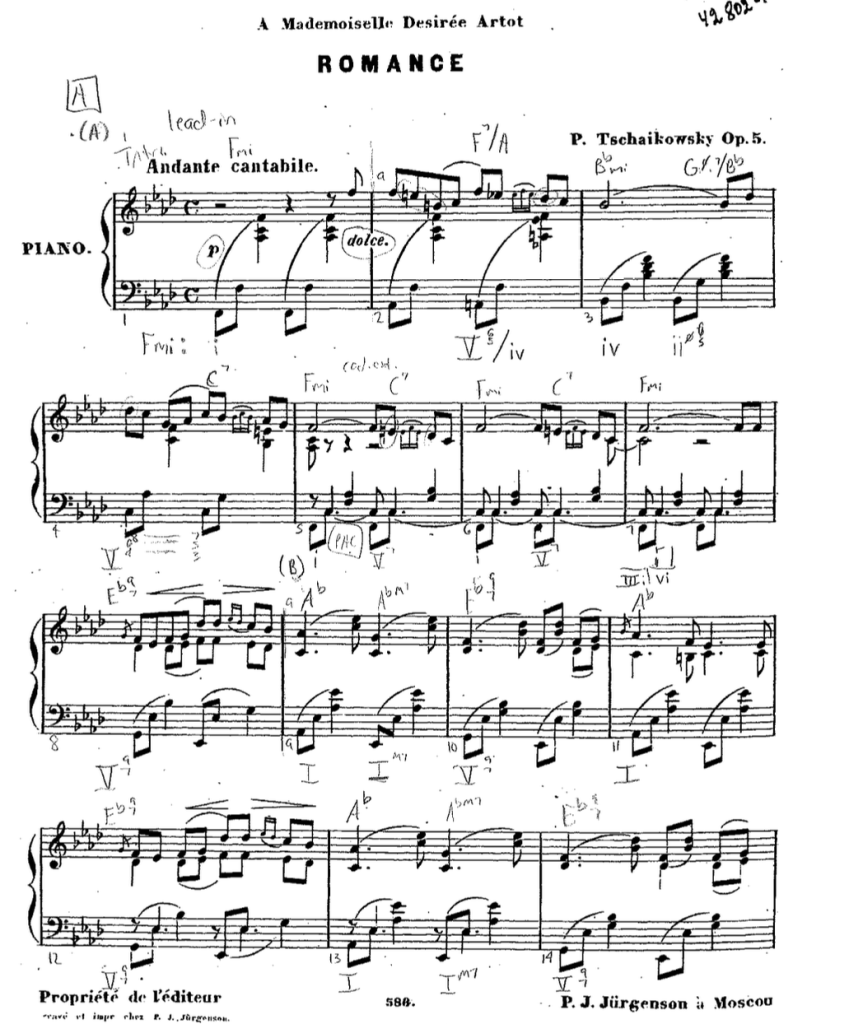
Tchaikovsky composed the Romance in F minor, Op. 5 in November 1868. It was first performed in December of that same year by pianist Nikolay Rubinstein at Moscow University, then later premiered by him at St. Petersburg in 1869. The piece is 106 measures long, it is one movement long (andante cantabile), and it is in ABAB form. It is one of his early works for solo piano, and it was dedicated to Mademoiselle Desiree Artot, a Belgian soprano who was with the Italian Opera Company in Moscow. Tchaikovsky and Artot were in a relationship and briefly engaged at the time. Not a lot of information was found on how it was generally received. The only feedback found was provided by Wiley:

“The Romance op.5, dedicated to Artôt, may refer to Artôt and Tchaikovsky in its principal themes, an operatic cantabile which echoes the lyric of Chopin’s nocturnes blatantly juxtaposed with a Russian dance. Laroche observed that the two did not go well together, an unwitting affirmation of the composer’s possible subtext, that the two persons did not go well together either.”

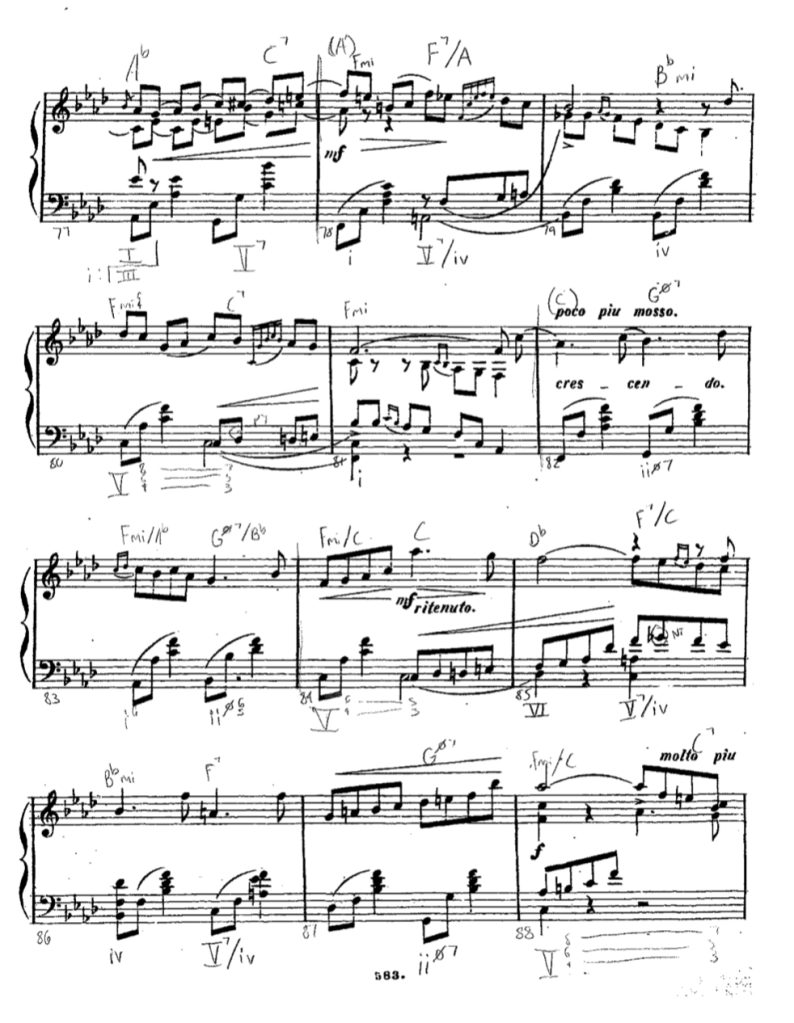
The A section is from measures 1-35, and it has 4 subsections (A-B-A’-C). It starts off at a piano dynamic, and it is andante cantabile. The first measure is actually a lead-in with arpeggios in the bass clef that leads to F minor chords in the treble clef, and all this is done with the LH (left hand). The melody actually gets introduced in the pick-up to measure 2, and its articulation style is dolce. What is interesting is that the melody is already introducing chromatic non-chord tones, which takes the tonal focus away from F minor. The melody is constantly moving, it has ornamentation, and it is very singable. The LH would play octaves in beats 1 and 3 and chords in beats 2 and 4. The chord progression at the beginning is as follows: i-V65/iv-iv-ii half-dim65-V864-753. In. m5, we have a PAC, but this is followed by a cadential extension that repeats to the downbeat of m.7. It is in this measure that the music starts modulating to the key of Ab major using the Fm chord as the pivot chord. In the b subsection, the melody becomes more harmonious. The RH (right hand) now plays chords while the LH continues what it did in the A subsection. The harmony becomes more colorful this time. It goes from I to IM7 to V97. At first, it seemed odd that the tonic chord would go to a major seventh form and the dominant chord would have a 9th, However, the score shows the seventh and ninth chord degrees were active in the music and were not just passing tones. This added some brilliance to this section of the music. This repeats until m. 15 when the Ab chord goes to a C dominant seventh chord instead. Also, the melody is rising and starts showing a little bit of independence from just playing chords, and there are a few chromatic non-chord tones. The crescendo helps signify a change to something different in the music. We get to the a’ subsection at m. 16. It mostly repeats what was shown in the A subsection, but it’s condensed to 4 measures. There is a PAC at m. 19, and the LH plays a descending arpeggio into the next subsection. The c subsection starts in m. 20 with a crescendo and a poco piu mosso. The LH alternates from playing arpeggios and chords to playing stepwise harmony. There is more dynamic variety in this subsection than seen before in the piece so far, with crescendos, decrescendos, and different dynamic settings. The music relaxes from m. 28-35 as it goes to piano, and the rhythmic activity decreases. At m. 32, the RH has an ostinato figure that sets up the new section and tonality as the G natural changes to Gb. The music also accelerates and crescendos as this occurs.

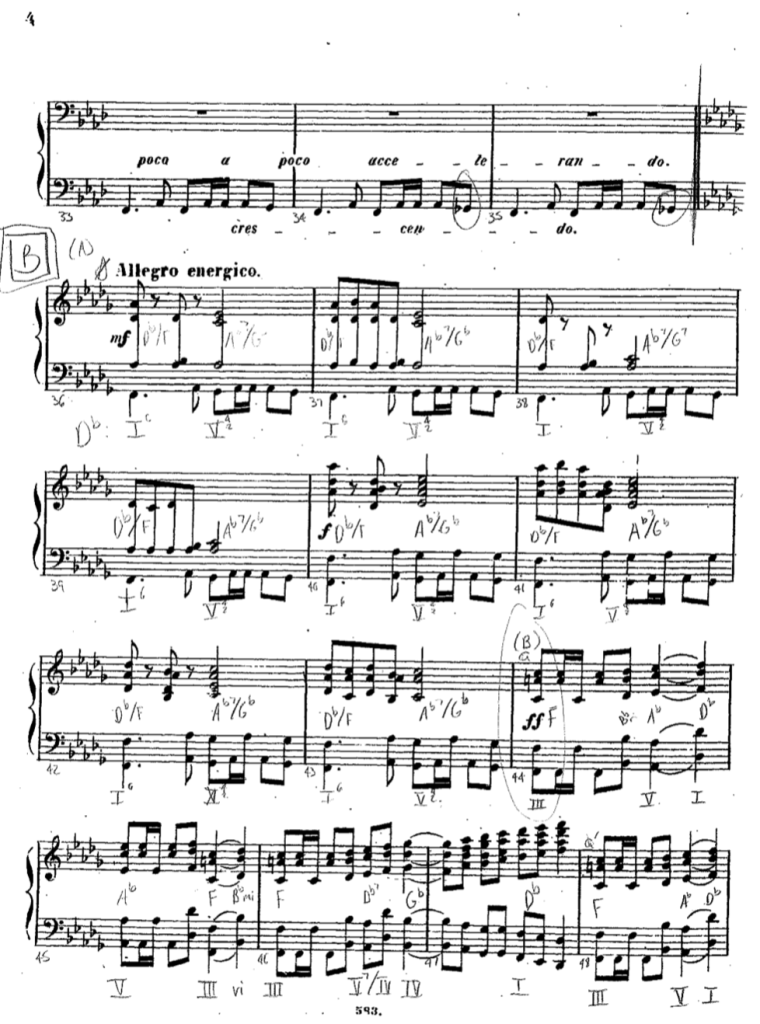
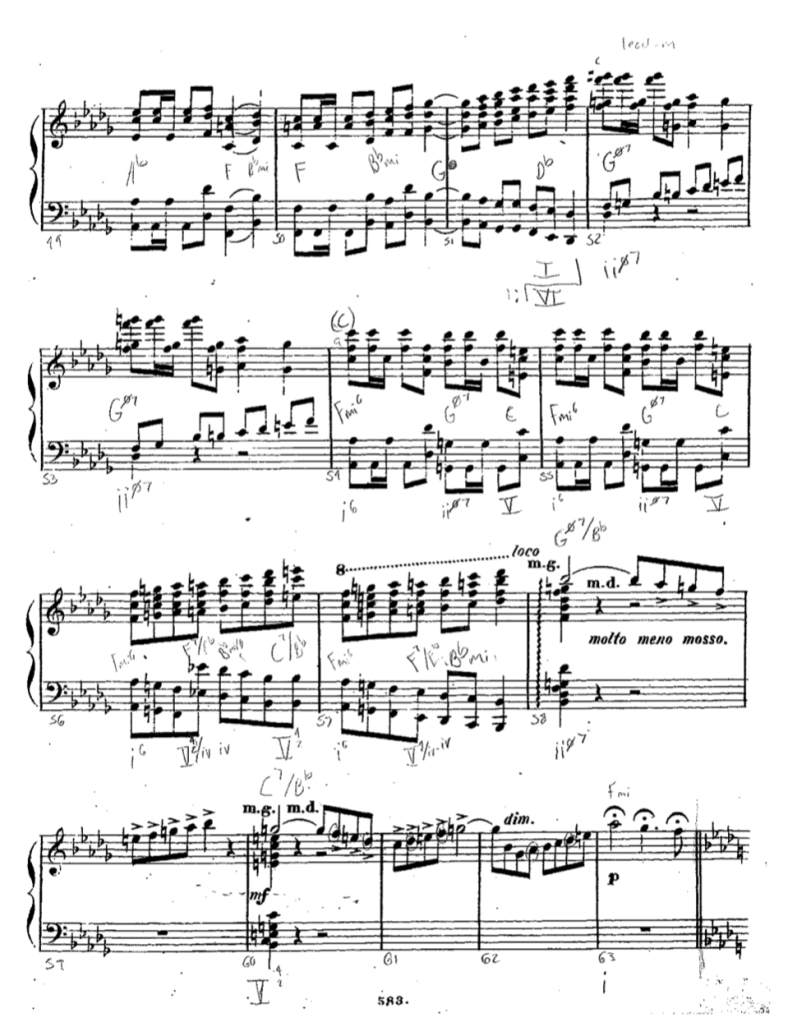
The B section is from measures 36-63. It is now at a mezzoforte dynamic, and it is allegro energico. This could be the Russian Dance part of the music that was mentioned earlier. It has switched to the key of Db major, a closely-related key to F minor. In the a subsection, the harmony just switches back and forth between the tonic chord in first inversion and the dominant seventh chord in third inversion. The RH alternates back and forth between being rhythmic and just doing chords. The LH has an ostinato figure, and it only changes at m. 40 by adding octaves. Seeing as this subsection just alternates chords, there is no actual cadence and no sense of finality. A harmonic elision actually takes place at the start of the b subsection as the harmony goes from Ab7 to a F major chord. In the b subsection, the dynamic goes from mezzoforte to fortissimo. The music becomes homorhythmic for both hands, and the rhythm gets more active, helping establish that fun dance groove. The music has more harmonic motion. At m. 47 and 51, the music expands its range with the RH ascending while the LH descends. In m. 52, the music breaks out of the homorhythm with the LH ascending in stepwise motion and the RH repeating the G half-diminished seventh chord, but in different octaves. In the c subsection that starts at m. 54, the homorhythm returns for four measures. There is not as much harmonic motion as in the b subsection. The RH is a little more open with its chords and is also high in range. In. m.56-57, the RH plays ascending chords while the LH plays descending octaves. At m. 58, there is an ascending arpeggio of the G half-diminished seventh chord. The music slows down with the molto meno mosso, and the RH plays through the chord, but in stepwise motion. At m.60, the process repeats. This time, it’s with a C dominant seventh chord, and there is a diminuendo to foreshadow the return to the A section. The fermatas and the piano dynamic at m. 63 confirm the return to the F minor tonality and a return to the A section.

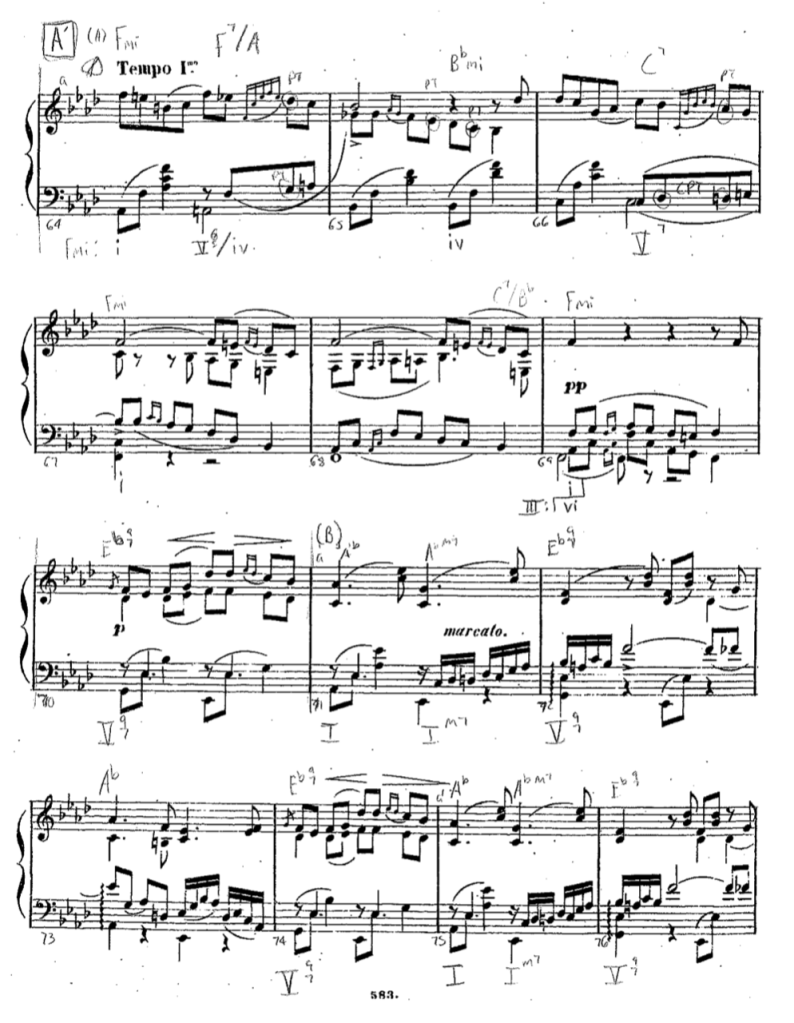
The A’ section is from measures 64-90. It is back to the piano dynamic, and it is also back to tempo primo. It is back in the key of F minor. It started off in a similar fashion to that of the first A section. The LH was more active as a countermelody while the RH played the same melodic line from before with some added harmony. In the b subsection, the modulation into the key of Ab major returns. The harmonic progression was basically the same as before. What was different was how the LH was rhythmically active with 16th notes, and this was played with the marcato style of articulation. The RH was almost the same as before, with some added eighth rests not present before. The last measure of this subsection has the same function as in the first A section, serving as a transition into the next part of the music while modulating back into the key of F minor. The a’ subsection seems like a mix of the a’ subsection from the A section and the a subsection from earlier. It’s four measures long, and the melodic activity from the a subsection returns. Meanwhile, the LH plays the harmonic activity from the beginning. The c subsection is almost the same from the one in the A section. M. 90 is a transposed version of m. 89, and a mosso diminuendo takes place during these two measures.

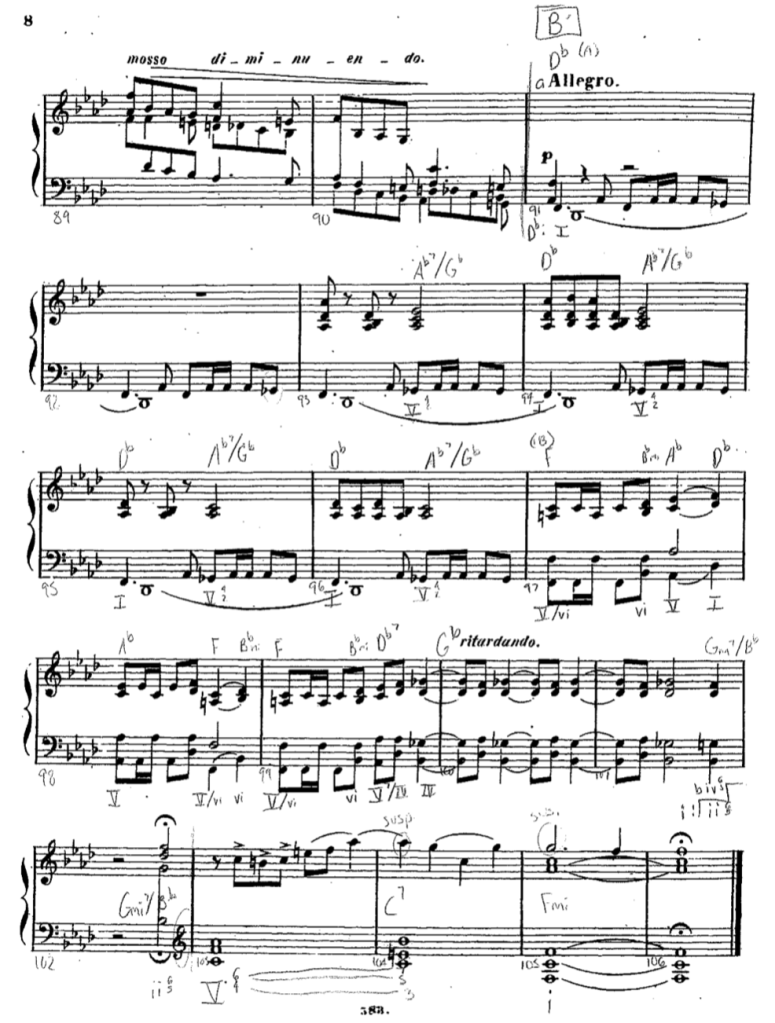
The B’ section is from measures 91 to the end. Unlike the first B section, this B’ section stays at the piano dynamic, and it is allegro. Also, the key signature stays in the key of F minor, but the tonality has modulated to the key of Db major as seen by the accidental Gbs. M. 91-92 could be seen as an introduction since there is no activity in the RH until the third measure (m.93). At m. 93, we have the same four measures as the beginning of the B section. Afterward, it advances to the b subsection. Here, the harmony in the RH has been taken down an octave. Even in m. 99-100, the RH doesn’t ascend that much in range as it did in the first B section. This gives the music more of a somber tone than before. In m. 100-101, the music has a ritardando as it goes from a Gb chord to a Gm7 chord, which is seen as the pivot chord to modulate back into the key of F minor. This is confirmed in m. 103 when the LH sustains a cadential C64 chord while the RH moves in stepwise motion through that chord. The music then returns to F minor at m. 105, but what is interesting is the G5 that suspends before resolving down to the F. This gives the music a bit of tension and not wanting to release before finally doing so to end the piece.

Even though this is one of Tchaikovsky’s early works, it is a fine piece of music. Contrary to what was mentioned earlier regarding its juxtaposition of Chopin’s influence and the Russian dance, it did not sound bland or forced. The tune did a great job of transitioning and mixing the two styles. Even with a simple start, Tchaikovsky made sure to integrate his ideas with chromaticism. As the tune progresses, the interesting harmonies, the clever modulations, how Tchaikovsky plays with how the hands play in different sections, and the way dynamics are played out will keep a listener guessing where the music might go next, even if the music has a bit of repetition. Though no information on how the music was received critically at its time of premiere was found, hopefully Artot appreciated Tchaikovsky’s dedication to her through this piece. This is a piano piece that should be performed more frequently.

Omar A. Cordova

Bibliography

The Myth of Paganini and the Devil

Picture: Getty

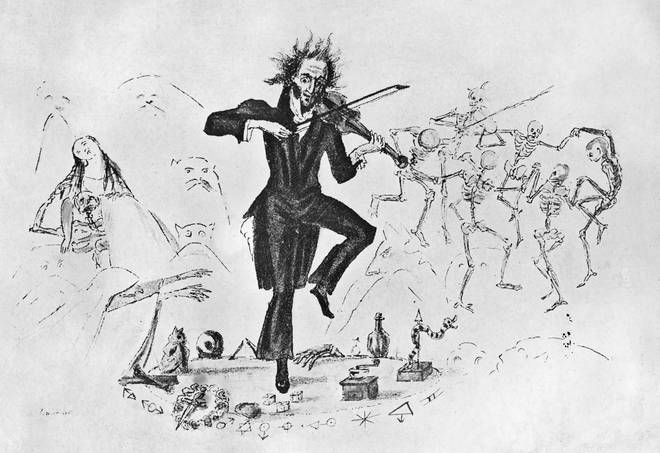
Drawing by a Viennese caricaturist of Paganini “fiddling devilishly, surrounded by symbols of black magic- in the background a swooning woman, vague supernatural beasts, and a ring of dancing skeletons.”

In an article written in 1939 by The Musical Times, Joanne Holbrook concludes that “We are unable today to offer any more adequate explanation of his playing than those who, in his lifetime, insisted that some supernatural power was the only possible solution to the Paganini mystery.”  This is an example of the time period as an important factor in determining how history is written.  Medical research and science had not advanced to an adequate stage to be able to explain the ability of the great violinist in 1939, and certainly not during the life of Niccolò Paganini(1782-1840).  Journalists, music critics, and attendees of Paganini’s concerts continued to spread the multiple rumors about Paganini, and chief among these the idea that he had an association with the Devil.  All in all, it seems that the artist himself had little say about what people thought of him.  History was written by those who thought it best to sensationalize a musical figure with such amazing ability, and rumors continue, even today, to be the first one hears about Paganini.

“His G string was the intestine of his wife, whom he had murdered with his own hands”, began a rumor made in response to the great violinist’s skill playing on a single string.  People continued to spread rumors such as the fact that the devil was seen assisting Paganini on stage, and the a London magazine published a dialogue between Paganini and the devil, in which his soul was exchanged for unholy musical skill.  The story most accepted during his lifetime was that he had murdered his wife, and during a long period in prison, he practiced violin so much that when he was let out, he was able to play better than any other violinist ever known and completely surprise musicians and critics all over the world. According to The Times of the period, the most skillful violinists declared that not only was it incredibly difficult to play Paganini’s compositions, but they could not even imagine how it was possible.

Even after his death, people were said to have heard the screeching of a violin at night and saw little devils dancing around his coffin.  Of course, Paganini’s physical appearance and aesthetic did not help his case.  His long limbs, skeletal facial features, narrow chest, claw like long fingers, piercing eyes, and later toothlessness stood out.  He would show up to concerts “dressed all in black, entering the scene on a black stagecoach dragged by black horses.”  Furthermore, his musical ability and the sound of his compositions were unlike anything ever seen or heard before and gave him a unique personality that led people to believe fantastical rumors about him.

Paganini and his friends never stopped denying the rumors.  He once terrified guests at a dinner party by moving his knife around wildly and saying that his dead wife was haunting him because of his deeds. This was his way of making fun of the ridiculous stories told about him.  A published statement read that “in reality a person of the gentlest and most inoffensive habits, he is anything rather than the desperate ruffian he has been described.”  He was known to be devoted parent to his natural son, and sent lots of money to other close family members and relatives in order to care for their wellbeing.  Paganini did a lot of charitable deeds as well, according dozens of letters from thankful charities and other associations, and this was partly to persuade the public that the rumors of his demonic association were false.

Many stories, as well as letters sent by Paganini and from those who knew him showed him to be a financially savvy person and stingy when it came to his performances, but no more than what would be expected of a great musician.  Rumors of his meanness were written by those who were motivated to do so.  For instance, one harpist who played in a concert with Paganini invited him to her own concert, and he declined, which led her to publish a letter to him about why he was so wrong to deny her.  Once when the great violinist became ill and could not perform for a time, a journalist named Janin wrote many terrible things about him, and only years later withdrew his accusations.

In reality, according to a 2015 article “Niccolo Paganini: The hands of a genius”, Paganini was said to be a man stricken by many diseases, one of these being Marfan Syndrome.  By studying the paintings of Lyser, his personal portraitist, and a mold of Paganini’s right hand, the author’s sought information about why Paganini’s hands were so unique. From the artist’s drawings, an aracnodactilia, or spider hand, can be observed, which is a key feature of Marfan Syndrome.  A letter written by the Ragusano magistrate Matteo Niccolo de Ghetaldi stated “It is extraordinary what he can do with his hand.  He literally bends his figners… he can stretch his thumb as far to the left to wrap it around his little finger… he moves his hand as if there were no muscles nor bones around his joints.” Descriptions such as these furthered strengthened the Marfan diagnosis. 

In the end, the rumors about Paganini were all debunked.  His physical state was due to the diseases he likely had, and he reportedly had used mercury to treat syphilis he had contracted which would have made him toothless.  According to medical experts regarding his supernatural ability to play the violin, “In our opinion, an unrepeatable scenario occurred in him, where brain activity brilliance was matched to a hyper-mobile hand and fingers, resulting probably from a defect if judged in the strict sense of the word, which in reality gave origin to the unrepeatability of this genius.”  His hands were abnormal and the joints within them were extremely lax and his condition did not limit their movement, but did just the opposite.  Finally, Paganini died of the very human disease of laryngeal phthisis.

History is determined by those who write it, and unfortunately many times opinion and rumor can be misconstrued as fact.  As we saw from the beginning of this article, the time period in which a historical event is written is also partially at fault for false statements, but this cannot be helped when information is not available to support claims.  Paganini was such an awe inspiring figure that his abilities were difficult to comprehend even by the best musicians of the time.  Now with medical and scientific advances, better research can be done to draw conclusions that are closer to the truth.  Until permission is given to do a DNA test on his remains, experts will remain uncertain as to the exact cause of Paganini’s abnormal ability, but it most certainly is not the work of the devil.

Preston Griffith

Holbrook, Joanne. “Paganini: Infernal, Human, or Divine.” The Musical Times 80, no. 1155 (1939): 364-65. Accessed January 29, 2020. doi:10.2307/922247.

Pedrazzini, Alessio & Martelli, Alessandra & Tocco, Silvio. “Niccolò Paganini: The hands of a genius.” Acta bio-medica: Atenei Parmensis, no. 86 (2015): 27-31.

Výborný, Zdeněk. “The Real Paganini.” Music & Letters 42, no. 4 (1961): 348-63. Accessed January 29, 2020. http://www.jstor.org/stable/732771.

Historical Narratives: Fact or Fiction?

Andrea Davis

When studying history, one often assumes they are dealing with the truth—facts as they have actually happened. However, to gain a clear and more accurate picture of the details surrounding people and events, one must be more discerning. Personal bias, political agendas, financial gain, and even stereotypes may all serve to color a historical narrative. Misrepresentation can be perpetuated both intentionally and unintentionally; the former, if not blatantly unethical, is inarguably dishonest. When examining the lives of Tchaikovsky and Shostakovich, it is a challenge to determine which details are authentic. Sorting fact from fiction is essential in order to gain a reliable portrait of the two men.
Many of the myths surrounding Tchaikovsky seem to have stemmed from a desire for sensationalism. He has been depicted as a tortured soul prone to self-destruction, with the belief that his artistic temperament and homosexuality could only support this characterization. The fact that Tchaikovsky had a preference for privacy (whether in an attempt to conceal his sexuality or because he was private in nature), only served to add to his curious appeal. When he died suddenly in 1893, rumors of suicide were rampant, with his supposed motivations ranging from shame and self-loathing over his sexuality or his failed marriage to government interference. Long held Western prejudices toward Russians only made these myths and rumors easier to believe.
Adding to the confusion is the Soviet government’s inconsistent treatment of Tchaikovsky. Initially, his music was criticized as being incongruous with the working class and their interests. Later, he was celebrated and lauded as a national treasure. This complete reversal in government opinion required that texts previously written about Tchaikovsky now be revised. The ambiguity of official public opinion, combined with government censorship of communication, only clouded the truth about Tchaikovsky.
Where the myths surrounding Tchaikovsky seem to have been mostly without malice, the misinformation surrounding Dimitri Shostakovich was more willfully constructed. Despite the fact that Shostakovich is considered one of the greatest mid-20th century composers, his creative output was often restricted by political interference. He enjoyed fame and a favorable endorsement in the political sphere, but at the same time endured censorship for his work and writing. He was even made to give speeches under duress. Nothing in Shostakovich’s personal history would point toward his being an extreme political activist, and yet that is the persistent impression that surrounds his life and works. This is in large part due Testimony: The Memoirs of Dimitri Shostakovich as Related to and Edited by Solomon Volkov. Volkov paints Shostakovich to be a bitter political dissident. Sadly, Volkov’s Testimony was both unsupported by any proof and readily believed to be fact . This perpetuated characterization of Shostakovich as a political rebel has colored the interpretation of his works. His biographical “facts” (as reported by Volkov) have been reiterated in program notes, CD jackets, websites and books. In 1988, a movie by the same title (Testimony) was produced and advertised as a fascinating portrayal of the life of Shostakovich. An article reviewing the movie claims, “Testimony surpasses biography and is akin to self-portrait.” High—and ridiculous—praise when once considers the source. Volkov’s memoir did not meet without criticism, and he tried to discredit anyone (including Shostakovich’s widow) who sought to contradict his work. Nevertheless, Testimony has been wildly successful and its information extremely pervasive.
In both cases, looking to original sources (and of course, multiple sources) helps to clear the confusion. In his own writing, Tchaikovsky acknowledged his easily changing emotions, and declared that despite his interest in melancholy musical ideas, he himself was happy. His declarations, coupled with medical evidence, makes the idea of a suicide appear rather impossible. Shostakovich was less forthcoming in his personal correspondence, and indeed destroyed or censored most of the letters he wrote and received. Even in the absence of extensive personal records, the lack of credible sources for Volkov’s work ought to at the very least make one read his claims more critically.
Common sense suggests that one must look at all sources objectively, and that research and scholarship ought to endeavor to illuminate the most authentic picture possible. However, when myths and fictions are so prevalent that they become fact, it can be difficult to see through the confusion. It is necessary to be aware of any bias (including one’s own) if one is to contribute anything of lasting value.

Bibliography
Fairclough, Pauline. “Facts, Fantasies, and Fictions: Recent Shostakovich Studies.” Music & Letters 86, no. 3 (2005): 452-60. Accessed January 29, 2020. http://www.jstor.org/stable/3526611.

Fay, Laurel. “Katerina Izmaylova.” Grove Music Online. 2002; Accessed 29 Jan. 2020. https://0-www-oxfordmusiconline-com.lib.utep.edu/grovemusic/view/10.1093/gmo/9781561592630.001.0001/omo-9781561592630-e-5000006871.

Fay, Laurel, and David Fanning. “Shostakovich, Dmitry.” Grove Music Online. 2001; Accessed 29 Jan. 2020. https://0-www-oxfordmusiconline-com.lib.utep.edu/grovemusic/view/10.1093/gmo/9781561592630.001.0001/omo-9781561592630-e-0000052560.

Glicksman, Marlaine. “Citizen Artist: On Shostakovich and the Soviets.” Film Comment 24, no. 6 (1988): 50-51. Accessed January 29, 2020. http://www.jstor.org/stable/43452465.

Pozansky, Alexander. “Tchaikovsky: The Man Behind the Myth.” The Musical Times 136/1826 (1995): 175-182.

Design a site like this with WordPress.com
Get started