The piano trio, originally written as a harpsichord obligato with string accompaniment in the late Baroque era, later evolved to have a more prominent keyboard part and an important violin dialogue. Beethoven and Schubert pushed the role of cello in the piano trio from one of accompaniment to one of prominence. Though some piano trios of the 19th century may favor the keyboard, the general trend moved toward composing with brilliance in all three parts. Tchaikovsky’s Piano Trio in A Minor falls squarely into the virtuosic category and requires excellence from each musician.
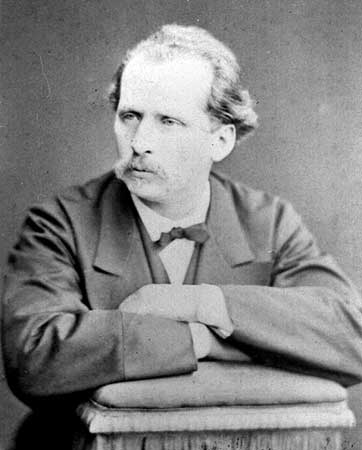
Tchaikovsky disliked the genre of piano trio, suggesting that the sound combination of piano and string instruments was unpleasant and unnatural. However, he decided to set himself to the task in December 1881. By January 1882, Tchaikovsky finished his Piano Trio in A minor and was pleased with his composition. He dedicated the trio to Nikolay Rubinstein (who died unexpectedly from tuberculoses in March 1881) with the words, “To the memory of a great artist.”
Tchaikovsky’s Piano Trio in A Minor is unusual in that is has only two movements instead of the typical four. The first movement is in sonata form. The second movement is a theme and variations with a finale and coda.
The first movement begins in A minor, with the cello and then the violin presenting the mournful melody. The piano takes a turn with the theme before moving into the second theme (written in E major.) The second theme feels more hopeful, and it is developed between all three instruments. The development, which begins in A minor, takes us through our recognizable themes and uses motives and sequences to take us through a chromatic shift in keys from B major, B flat Major, then A major. The effect is both emotional and warm. As expected the main theme returns in A minor. To end this movement, the harmony stays on an A minor pedal while the music almost fades out. The themes in this movement could be described as heartbreaking, beautiful, and even tender, which seems fitting for an elegy.
The second movement begins with an introduction to the theme in E major, which was inspired by Tchaikovsky’s memories of a pleasant day spent with Rubinstein and friends in a scenic part of Moscow. Solo piano lends simplicity to the introduction, creating a pastoral feel. There are 11 variations, followed by a Finale and Coda. The variations include a waltz, a fugue, a mazurka, and textures run from light and fanciful to orchestral at times. Each variation feels like a captured memory. The finale begins in A major, and is playful and upbeat with an almost frenetic energy about it. All three instruments interplay and exchange throughout the finale, weaving the motive from the first variation into the hopeful music. The frantic energy rushes into heavy A minor chords that lead into the coda. Here, the main theme from movement 1 returns. The piano plays huge, dramatic chord and scale passages while the cello and violin play the mournful melody in unison. The passionate coda dissolves into a funeral march-like ending and the piano fades out playing octaves alternating on I and V.
Tchaikovsky’s Piano Trio succeeds in showing all three instruments to advantage, never leaving one to fill a purely accompanistic role for long. His melodies are expressive and beautiful. As a tribute to a dear friend, the piano trio effectively paints a picture of deep and heartfelt emotion. Its virtuosity will appeal to musicians and audiences, and is an impressively gorgeous work in the piano trio canon.
Andrea Davis
Listen to Tchaikovsky’s Piano Trio in A Minor, Op. 50:
Bibliography
Brown, David. Tchaikovsky: The Man and His Music. New York: Pegasus Books, 2007.
Tchaikovsky Research contributors, “Piano Trio,” Tchaikovsky Research, , http://en.tchaikovsky-research.net/index.php?title=Piano_Trio&oldid=68581 (accessed February 27, 2020).
Tilmouth, Michael, and Basil Smallman. “Piano trio.” Grove Music Online. 2001; Accessed 27 Feb. 2020. https://0-www-oxfordmusiconline-com.lib.utep.edu/grovemusic/view/10.1093/gmo/9781561592630.001.0001/omo-9781561592630-e-0000021647.
Wiley, Roland John. “Tchaikovsky, Pyotr Il′yich.” Grove Music Online. 2001; Accessed 27 Feb. 2020. https://0-www-oxfordmusiconline-com.lib.utep.edu/grovemusic/view/10.1093/gmo/9781561592630.001.0001/omo-9781561592630-e-0000051766.
 Tchaikovsky Seminar