
Tchaikovsky composed the Romance in F minor, Op. 5 in November 1868. It was first performed in December of that same year by pianist Nikolay Rubinstein at Moscow University, then later premiered by him at St. Petersburg in 1869. The piece is 106 measures long, it is one movement long (andante cantabile), and it is in ABAB form. It is one of his early works for solo piano, and it was dedicated to Mademoiselle Desiree Artot, a Belgian soprano who was with the Italian Opera Company in Moscow. Tchaikovsky and Artot were in a relationship and briefly engaged at the time. Not a lot of information was found on how it was generally received. The only feedback found was provided by Wiley:
“The Romance op.5, dedicated to Artôt, may refer to Artôt and Tchaikovsky in its principal themes, an operatic cantabile which echoes the lyric of Chopin’s nocturnes blatantly juxtaposed with a Russian dance. Laroche observed that the two did not go well together, an unwitting affirmation of the composer’s possible subtext, that the two persons did not go well together either.”
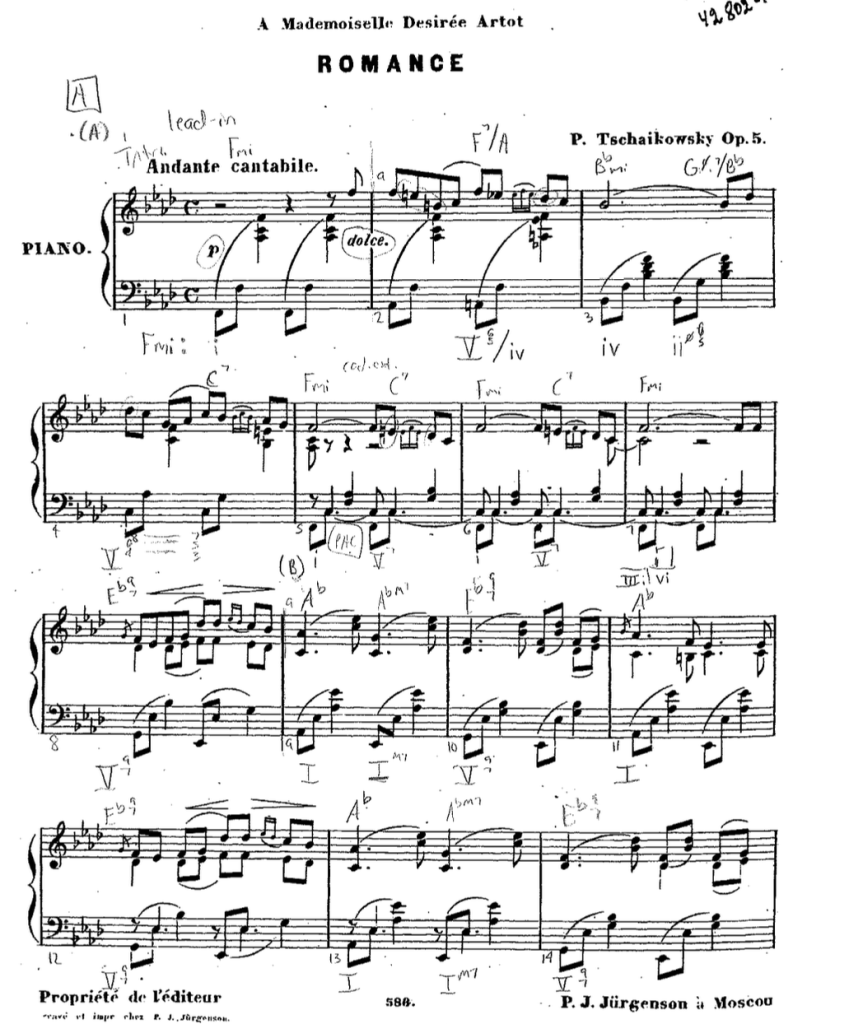
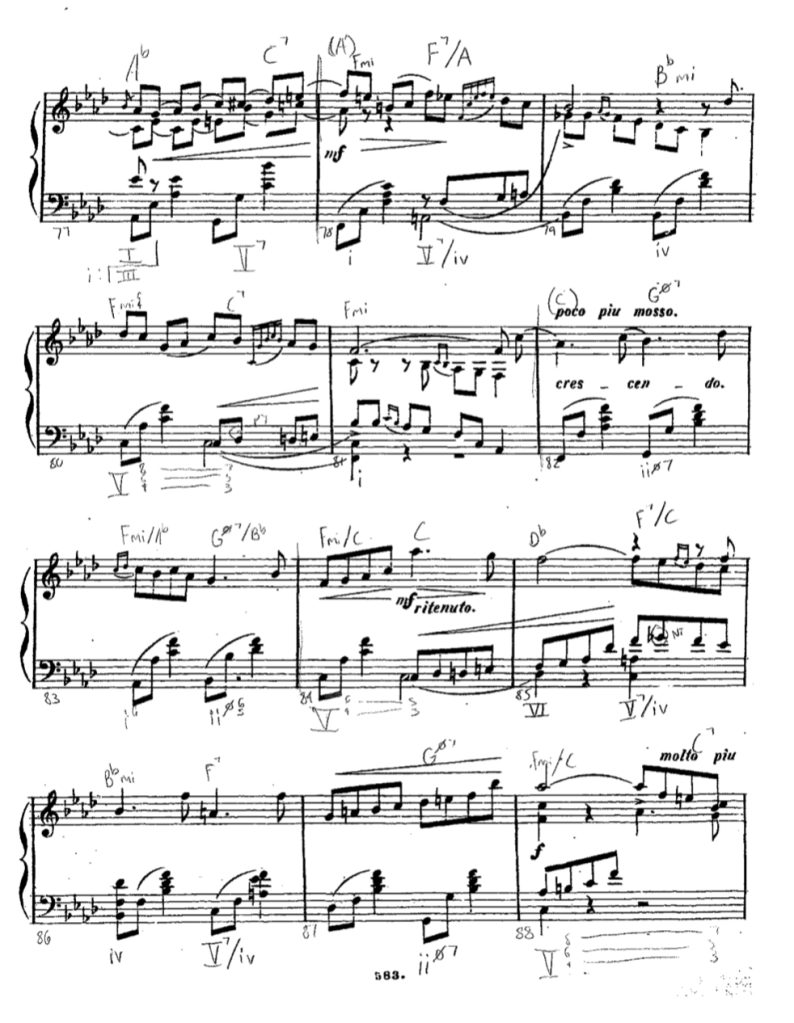
The A section is from measures 1-35, and it has 4 subsections (A-B-A’-C). It starts off at a piano dynamic, and it is andante cantabile. The first measure is actually a lead-in with arpeggios in the bass clef that leads to F minor chords in the treble clef, and all this is done with the LH (left hand). The melody actually gets introduced in the pick-up to measure 2, and its articulation style is dolce. What is interesting is that the melody is already introducing chromatic non-chord tones, which takes the tonal focus away from F minor. The melody is constantly moving, it has ornamentation, and it is very singable. The LH would play octaves in beats 1 and 3 and chords in beats 2 and 4. The chord progression at the beginning is as follows: i-V65/iv-iv-ii half-dim65-V864-753. In. m5, we have a PAC, but this is followed by a cadential extension that repeats to the downbeat of m.7. It is in this measure that the music starts modulating to the key of Ab major using the Fm chord as the pivot chord. In the b subsection, the melody becomes more harmonious. The RH (right hand) now plays chords while the LH continues what it did in the A subsection. The harmony becomes more colorful this time. It goes from I to IM7 to V97. At first, it seemed odd that the tonic chord would go to a major seventh form and the dominant chord would have a 9th, However, the score shows the seventh and ninth chord degrees were active in the music and were not just passing tones. This added some brilliance to this section of the music. This repeats until m. 15 when the Ab chord goes to a C dominant seventh chord instead. Also, the melody is rising and starts showing a little bit of independence from just playing chords, and there are a few chromatic non-chord tones. The crescendo helps signify a change to something different in the music. We get to the a’ subsection at m. 16. It mostly repeats what was shown in the A subsection, but it’s condensed to 4 measures. There is a PAC at m. 19, and the LH plays a descending arpeggio into the next subsection. The c subsection starts in m. 20 with a crescendo and a poco piu mosso. The LH alternates from playing arpeggios and chords to playing stepwise harmony. There is more dynamic variety in this subsection than seen before in the piece so far, with crescendos, decrescendos, and different dynamic settings. The music relaxes from m. 28-35 as it goes to piano, and the rhythmic activity decreases. At m. 32, the RH has an ostinato figure that sets up the new section and tonality as the G natural changes to Gb. The music also accelerates and crescendos as this occurs.

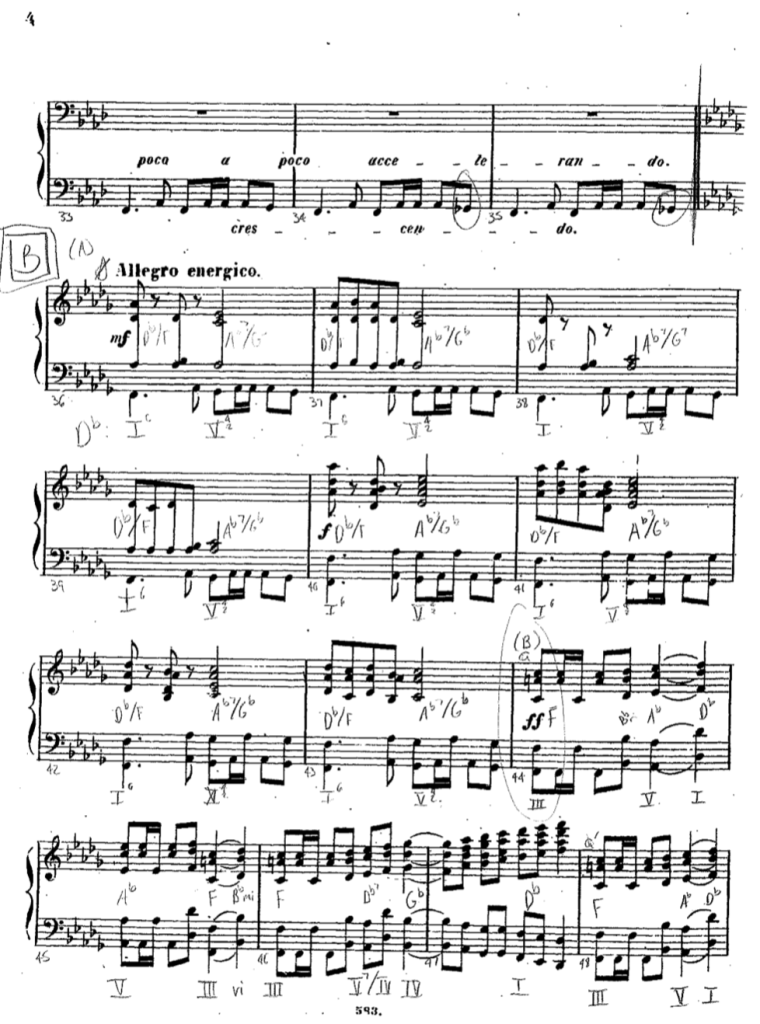
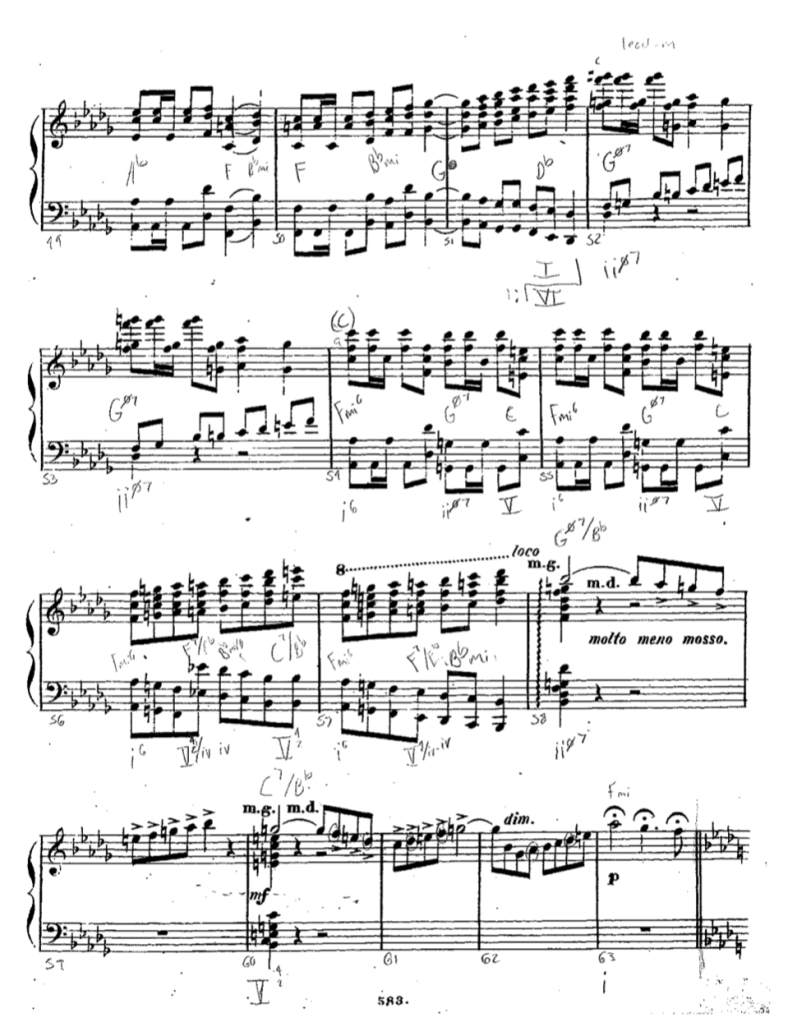
The B section is from measures 36-63. It is now at a mezzoforte dynamic, and it is allegro energico. This could be the Russian Dance part of the music that was mentioned earlier. It has switched to the key of Db major, a closely-related key to F minor. In the a subsection, the harmony just switches back and forth between the tonic chord in first inversion and the dominant seventh chord in third inversion. The RH alternates back and forth between being rhythmic and just doing chords. The LH has an ostinato figure, and it only changes at m. 40 by adding octaves. Seeing as this subsection just alternates chords, there is no actual cadence and no sense of finality. A harmonic elision actually takes place at the start of the b subsection as the harmony goes from Ab7 to a F major chord. In the b subsection, the dynamic goes from mezzoforte to fortissimo. The music becomes homorhythmic for both hands, and the rhythm gets more active, helping establish that fun dance groove. The music has more harmonic motion. At m. 47 and 51, the music expands its range with the RH ascending while the LH descends. In m. 52, the music breaks out of the homorhythm with the LH ascending in stepwise motion and the RH repeating the G half-diminished seventh chord, but in different octaves. In the c subsection that starts at m. 54, the homorhythm returns for four measures. There is not as much harmonic motion as in the b subsection. The RH is a little more open with its chords and is also high in range. In. m.56-57, the RH plays ascending chords while the LH plays descending octaves. At m. 58, there is an ascending arpeggio of the G half-diminished seventh chord. The music slows down with the molto meno mosso, and the RH plays through the chord, but in stepwise motion. At m.60, the process repeats. This time, it’s with a C dominant seventh chord, and there is a diminuendo to foreshadow the return to the A section. The fermatas and the piano dynamic at m. 63 confirm the return to the F minor tonality and a return to the A section.
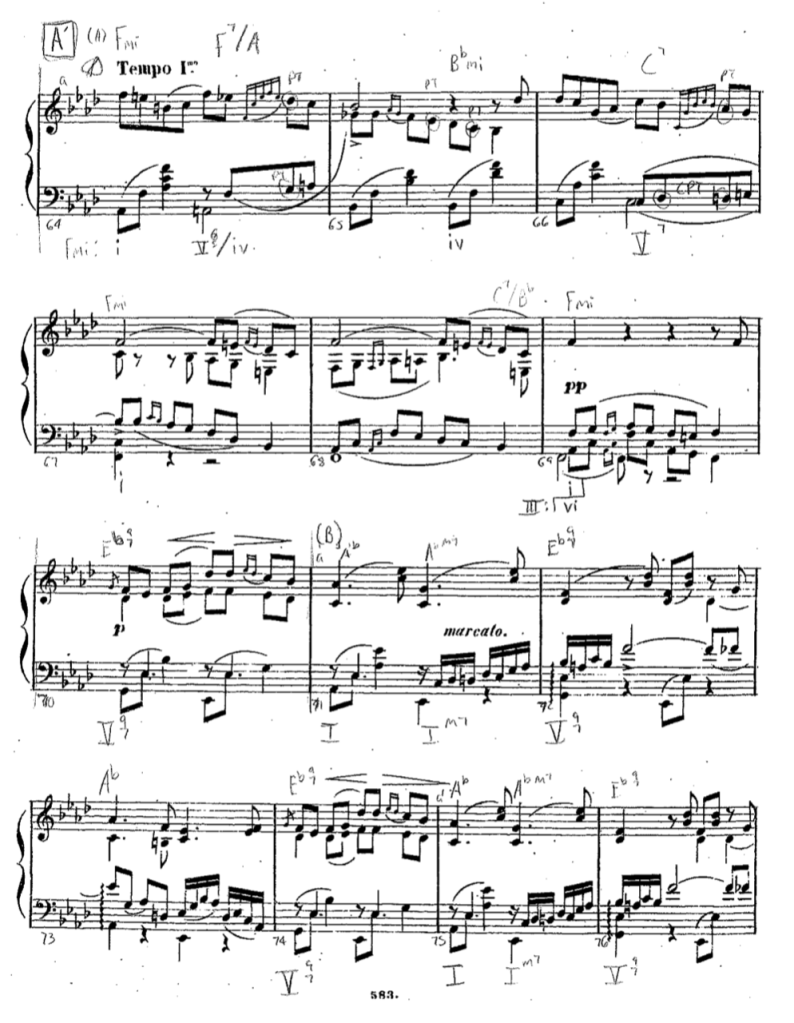
The A’ section is from measures 64-90. It is back to the piano dynamic, and it is also back to tempo primo. It is back in the key of F minor. It started off in a similar fashion to that of the first A section. The LH was more active as a countermelody while the RH played the same melodic line from before with some added harmony. In the b subsection, the modulation into the key of Ab major returns. The harmonic progression was basically the same as before. What was different was how the LH was rhythmically active with 16th notes, and this was played with the marcato style of articulation. The RH was almost the same as before, with some added eighth rests not present before. The last measure of this subsection has the same function as in the first A section, serving as a transition into the next part of the music while modulating back into the key of F minor. The a’ subsection seems like a mix of the a’ subsection from the A section and the a subsection from earlier. It’s four measures long, and the melodic activity from the a subsection returns. Meanwhile, the LH plays the harmonic activity from the beginning. The c subsection is almost the same from the one in the A section. M. 90 is a transposed version of m. 89, and a mosso diminuendo takes place during these two measures.
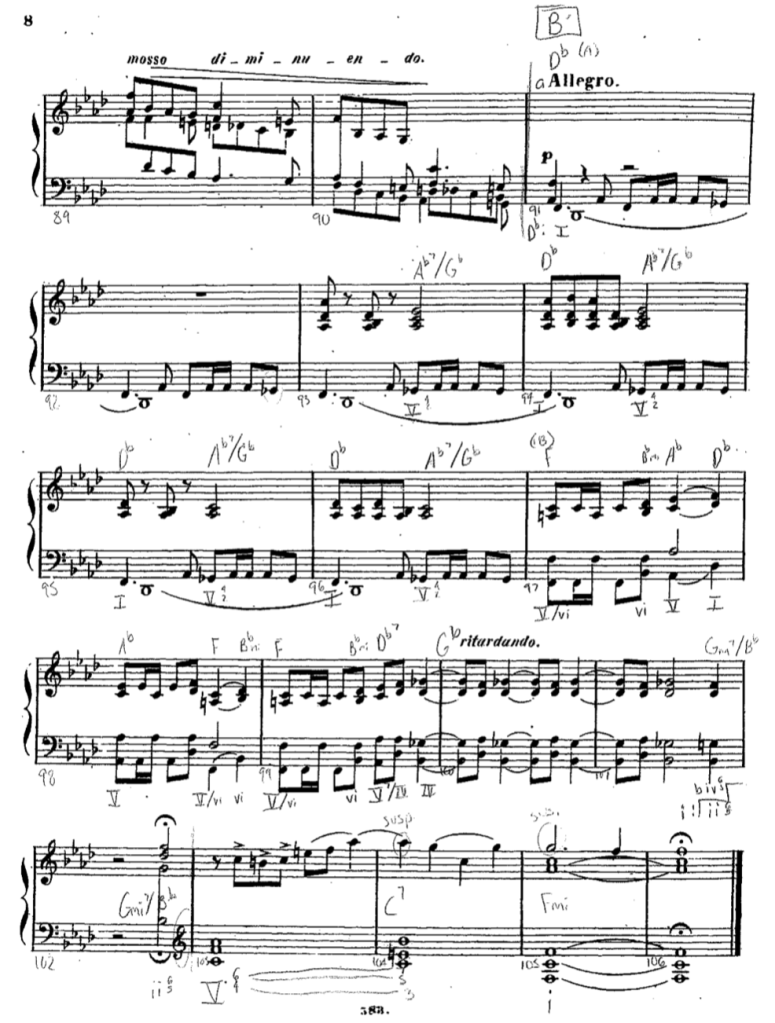
The B’ section is from measures 91 to the end. Unlike the first B section, this B’ section stays at the piano dynamic, and it is allegro. Also, the key signature stays in the key of F minor, but the tonality has modulated to the key of Db major as seen by the accidental Gbs. M. 91-92 could be seen as an introduction since there is no activity in the RH until the third measure (m.93). At m. 93, we have the same four measures as the beginning of the B section. Afterward, it advances to the b subsection. Here, the harmony in the RH has been taken down an octave. Even in m. 99-100, the RH doesn’t ascend that much in range as it did in the first B section. This gives the music more of a somber tone than before. In m. 100-101, the music has a ritardando as it goes from a Gb chord to a Gm7 chord, which is seen as the pivot chord to modulate back into the key of F minor. This is confirmed in m. 103 when the LH sustains a cadential C64 chord while the RH moves in stepwise motion through that chord. The music then returns to F minor at m. 105, but what is interesting is the G5 that suspends before resolving down to the F. This gives the music a bit of tension and not wanting to release before finally doing so to end the piece.
Even though this is one of Tchaikovsky’s early works, it is a fine piece of music. Contrary to what was mentioned earlier regarding its juxtaposition of Chopin’s influence and the Russian dance, it did not sound bland or forced. The tune did a great job of transitioning and mixing the two styles. Even with a simple start, Tchaikovsky made sure to integrate his ideas with chromaticism. As the tune progresses, the interesting harmonies, the clever modulations, how Tchaikovsky plays with how the hands play in different sections, and the way dynamics are played out will keep a listener guessing where the music might go next, even if the music has a bit of repetition. Though no information on how the music was received critically at its time of premiere was found, hopefully Artot appreciated Tchaikovsky’s dedication to her through this piece. This is a piano piece that should be performed more frequently.
Omar A. Cordova
Bibliography
- “Romance.” Romance – Tchaikovsky Research. Accessed February 12, 2020. http://en.tchaikovsky-research.net/pages/Romance.
- Wiley, Roland John. “Tchaikovsky, Pyotr Il′yich.” Grove Music Online. 2001; Accessed 9 Feb. 2020. https://0-www-oxfordmusiconline-com.lib.utep.edu/grovemusic/view/10.1093/gmo/9781561592630.001.0001/omo-9781561592630-e-0000051766.
 Tchaikovsky Seminar