Picture: Getty
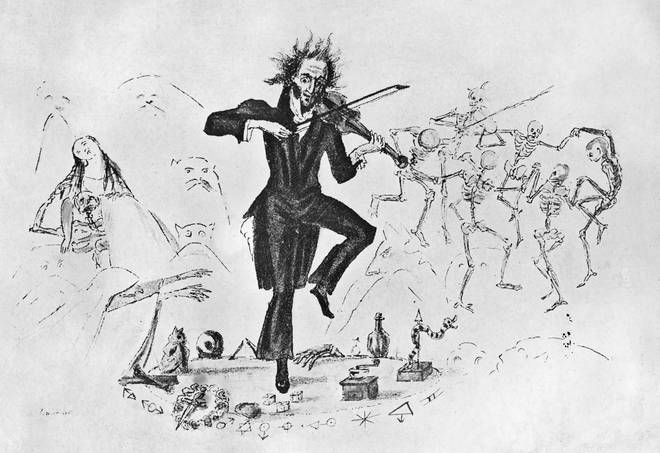
Drawing by a Viennese caricaturist of Paganini “fiddling devilishly, surrounded by symbols of black magic- in the background a swooning woman, vague supernatural beasts, and a ring of dancing skeletons.”
In an article written in 1939 by The Musical Times, Joanne Holbrook concludes that “We are unable today to offer any more adequate explanation of his playing than those who, in his lifetime, insisted that some supernatural power was the only possible solution to the Paganini mystery.” This is an example of the time period as an important factor in determining how history is written. Medical research and science had not advanced to an adequate stage to be able to explain the ability of the great violinist in 1939, and certainly not during the life of Niccolò Paganini(1782-1840). Journalists, music critics, and attendees of Paganini’s concerts continued to spread the multiple rumors about Paganini, and chief among these the idea that he had an association with the Devil. All in all, it seems that the artist himself had little say about what people thought of him. History was written by those who thought it best to sensationalize a musical figure with such amazing ability, and rumors continue, even today, to be the first one hears about Paganini.
“His G string was the intestine of his wife, whom he had murdered with his own hands”, began a rumor made in response to the great violinist’s skill playing on a single string. People continued to spread rumors such as the fact that the devil was seen assisting Paganini on stage, and the a London magazine published a dialogue between Paganini and the devil, in which his soul was exchanged for unholy musical skill. The story most accepted during his lifetime was that he had murdered his wife, and during a long period in prison, he practiced violin so much that when he was let out, he was able to play better than any other violinist ever known and completely surprise musicians and critics all over the world. According to The Times of the period, the most skillful violinists declared that not only was it incredibly difficult to play Paganini’s compositions, but they could not even imagine how it was possible.
Even after his death, people were said to have heard the screeching of a violin at night and saw little devils dancing around his coffin. Of course, Paganini’s physical appearance and aesthetic did not help his case. His long limbs, skeletal facial features, narrow chest, claw like long fingers, piercing eyes, and later toothlessness stood out. He would show up to concerts “dressed all in black, entering the scene on a black stagecoach dragged by black horses.” Furthermore, his musical ability and the sound of his compositions were unlike anything ever seen or heard before and gave him a unique personality that led people to believe fantastical rumors about him.
Paganini and his friends never stopped denying the rumors. He once terrified guests at a dinner party by moving his knife around wildly and saying that his dead wife was haunting him because of his deeds. This was his way of making fun of the ridiculous stories told about him. A published statement read that “in reality a person of the gentlest and most inoffensive habits, he is anything rather than the desperate ruffian he has been described.” He was known to be devoted parent to his natural son, and sent lots of money to other close family members and relatives in order to care for their wellbeing. Paganini did a lot of charitable deeds as well, according dozens of letters from thankful charities and other associations, and this was partly to persuade the public that the rumors of his demonic association were false.
Many stories, as well as letters sent by Paganini and from those who knew him showed him to be a financially savvy person and stingy when it came to his performances, but no more than what would be expected of a great musician. Rumors of his meanness were written by those who were motivated to do so. For instance, one harpist who played in a concert with Paganini invited him to her own concert, and he declined, which led her to publish a letter to him about why he was so wrong to deny her. Once when the great violinist became ill and could not perform for a time, a journalist named Janin wrote many terrible things about him, and only years later withdrew his accusations.
In reality, according to a 2015 article “Niccolo Paganini: The hands of a genius”, Paganini was said to be a man stricken by many diseases, one of these being Marfan Syndrome. By studying the paintings of Lyser, his personal portraitist, and a mold of Paganini’s right hand, the author’s sought information about why Paganini’s hands were so unique. From the artist’s drawings, an aracnodactilia, or spider hand, can be observed, which is a key feature of Marfan Syndrome. A letter written by the Ragusano magistrate Matteo Niccolo de Ghetaldi stated “It is extraordinary what he can do with his hand. He literally bends his figners… he can stretch his thumb as far to the left to wrap it around his little finger… he moves his hand as if there were no muscles nor bones around his joints.” Descriptions such as these furthered strengthened the Marfan diagnosis.
In the end, the rumors about Paganini were all debunked. His physical state was due to the diseases he likely had, and he reportedly had used mercury to treat syphilis he had contracted which would have made him toothless. According to medical experts regarding his supernatural ability to play the violin, “In our opinion, an unrepeatable scenario occurred in him, where brain activity brilliance was matched to a hyper-mobile hand and fingers, resulting probably from a defect if judged in the strict sense of the word, which in reality gave origin to the unrepeatability of this genius.” His hands were abnormal and the joints within them were extremely lax and his condition did not limit their movement, but did just the opposite. Finally, Paganini died of the very human disease of laryngeal phthisis.
History is determined by those who write it, and unfortunately many times opinion and rumor can be misconstrued as fact. As we saw from the beginning of this article, the time period in which a historical event is written is also partially at fault for false statements, but this cannot be helped when information is not available to support claims. Paganini was such an awe inspiring figure that his abilities were difficult to comprehend even by the best musicians of the time. Now with medical and scientific advances, better research can be done to draw conclusions that are closer to the truth. Until permission is given to do a DNA test on his remains, experts will remain uncertain as to the exact cause of Paganini’s abnormal ability, but it most certainly is not the work of the devil.
Preston Griffith
Holbrook, Joanne. “Paganini: Infernal, Human, or Divine.” The Musical Times 80, no. 1155 (1939): 364-65. Accessed January 29, 2020. doi:10.2307/922247.
Pedrazzini, Alessio & Martelli, Alessandra & Tocco, Silvio. “Niccolò Paganini: The hands of a genius.” Acta bio-medica: Atenei Parmensis, no. 86 (2015): 27-31.
Výborný, Zdeněk. “The Real Paganini.” Music & Letters 42, no. 4 (1961): 348-63. Accessed January 29, 2020. http://www.jstor.org/stable/732771.
 Tchaikovsky Seminar