Andrea Davis
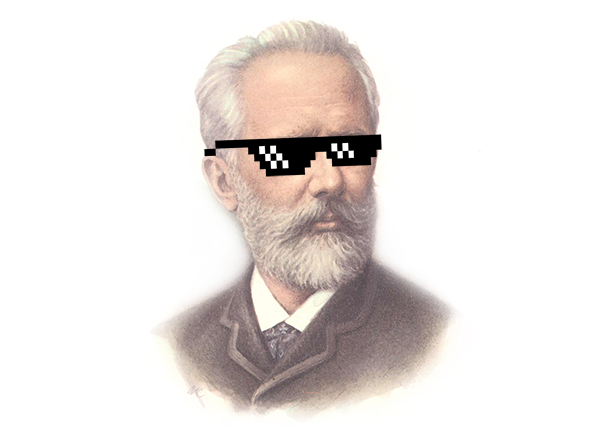
When studying history, one often assumes they are dealing with the truth—facts as they have actually happened. However, to gain a clear and more accurate picture of the details surrounding people and events, one must be more discerning. Personal bias, political agendas, financial gain, and even stereotypes may all serve to color a historical narrative. Misrepresentation can be perpetuated both intentionally and unintentionally; the former, if not blatantly unethical, is inarguably dishonest. When examining the lives of Tchaikovsky and Shostakovich, it is a challenge to determine which details are authentic. Sorting fact from fiction is essential in order to gain a reliable portrait of the two men.
Many of the myths surrounding Tchaikovsky seem to have stemmed from a desire for sensationalism. He has been depicted as a tortured soul prone to self-destruction, with the belief that his artistic temperament and homosexuality could only support this characterization. The fact that Tchaikovsky had a preference for privacy (whether in an attempt to conceal his sexuality or because he was private in nature), only served to add to his curious appeal. When he died suddenly in 1893, rumors of suicide were rampant, with his supposed motivations ranging from shame and self-loathing over his sexuality or his failed marriage to government interference. Long held Western prejudices toward Russians only made these myths and rumors easier to believe.
Adding to the confusion is the Soviet government’s inconsistent treatment of Tchaikovsky. Initially, his music was criticized as being incongruous with the working class and their interests. Later, he was celebrated and lauded as a national treasure. This complete reversal in government opinion required that texts previously written about Tchaikovsky now be revised. The ambiguity of official public opinion, combined with government censorship of communication, only clouded the truth about Tchaikovsky.
Where the myths surrounding Tchaikovsky seem to have been mostly without malice, the misinformation surrounding Dimitri Shostakovich was more willfully constructed. Despite the fact that Shostakovich is considered one of the greatest mid-20th century composers, his creative output was often restricted by political interference. He enjoyed fame and a favorable endorsement in the political sphere, but at the same time endured censorship for his work and writing. He was even made to give speeches under duress. Nothing in Shostakovich’s personal history would point toward his being an extreme political activist, and yet that is the persistent impression that surrounds his life and works. This is in large part due Testimony: The Memoirs of Dimitri Shostakovich as Related to and Edited by Solomon Volkov. Volkov paints Shostakovich to be a bitter political dissident. Sadly, Volkov’s Testimony was both unsupported by any proof and readily believed to be fact . This perpetuated characterization of Shostakovich as a political rebel has colored the interpretation of his works. His biographical “facts” (as reported by Volkov) have been reiterated in program notes, CD jackets, websites and books. In 1988, a movie by the same title (Testimony) was produced and advertised as a fascinating portrayal of the life of Shostakovich. An article reviewing the movie claims, “Testimony surpasses biography and is akin to self-portrait.” High—and ridiculous—praise when once considers the source. Volkov’s memoir did not meet without criticism, and he tried to discredit anyone (including Shostakovich’s widow) who sought to contradict his work. Nevertheless, Testimony has been wildly successful and its information extremely pervasive.
In both cases, looking to original sources (and of course, multiple sources) helps to clear the confusion. In his own writing, Tchaikovsky acknowledged his easily changing emotions, and declared that despite his interest in melancholy musical ideas, he himself was happy. His declarations, coupled with medical evidence, makes the idea of a suicide appear rather impossible. Shostakovich was less forthcoming in his personal correspondence, and indeed destroyed or censored most of the letters he wrote and received. Even in the absence of extensive personal records, the lack of credible sources for Volkov’s work ought to at the very least make one read his claims more critically.
Common sense suggests that one must look at all sources objectively, and that research and scholarship ought to endeavor to illuminate the most authentic picture possible. However, when myths and fictions are so prevalent that they become fact, it can be difficult to see through the confusion. It is necessary to be aware of any bias (including one’s own) if one is to contribute anything of lasting value.
Bibliography
Fairclough, Pauline. “Facts, Fantasies, and Fictions: Recent Shostakovich Studies.” Music & Letters 86, no. 3 (2005): 452-60. Accessed January 29, 2020. http://www.jstor.org/stable/3526611.
Fay, Laurel. “Katerina Izmaylova.” Grove Music Online. 2002; Accessed 29 Jan. 2020. https://0-www-oxfordmusiconline-com.lib.utep.edu/grovemusic/view/10.1093/gmo/9781561592630.001.0001/omo-9781561592630-e-5000006871.
Fay, Laurel, and David Fanning. “Shostakovich, Dmitry.” Grove Music Online. 2001; Accessed 29 Jan. 2020. https://0-www-oxfordmusiconline-com.lib.utep.edu/grovemusic/view/10.1093/gmo/9781561592630.001.0001/omo-9781561592630-e-0000052560.
Glicksman, Marlaine. “Citizen Artist: On Shostakovich and the Soviets.” Film Comment 24, no. 6 (1988): 50-51. Accessed January 29, 2020. http://www.jstor.org/stable/43452465.
Pozansky, Alexander. “Tchaikovsky: The Man Behind the Myth.” The Musical Times 136/1826 (1995): 175-182.
 Tchaikovsky Seminar